



The Internet of Underwater Things (IoUT): Connecting the Deep with Smart Marine Tech in 2026
The acoustic modem handshake failed at 14 meters, which was exactly where the thermocline had settled that morning. The surface vessel held station with dynamic positioning thrusters humming at forty percent load, throwing white noise straight down into the water column. Below, a seabed sensor node tried to reply through a layer of stratified water that bent sound waves like light through cracked glass. The deck terminal flashed “Packet Loss: 68%.” The survey technician didn’t panic. He just killed the azimuth thrusters, let the vessel drift, waited for the thruster wash to clear, and triggered the ping again. The modem synced. The data stream resumed. Nobody celebrated. It was Tuesday.
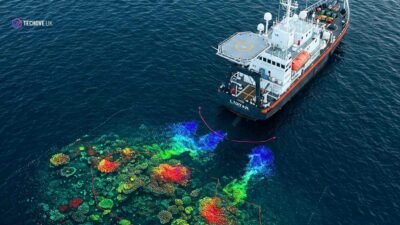
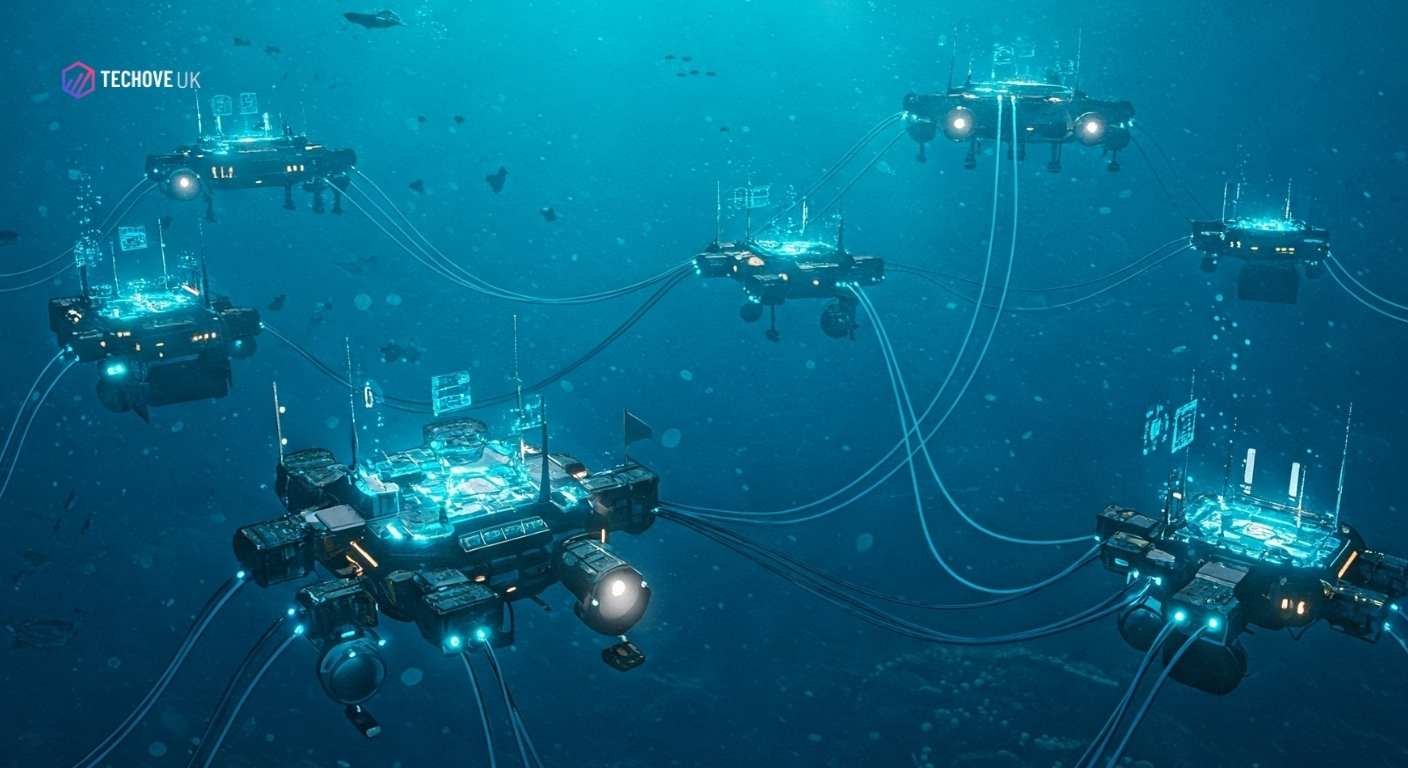
That moment captures why underwater networking resists clean deployment narratives. You don’t plug nodes into a switch and watch a network topology populate. You fight salinity gradients, vessel self-noise, multipath reflections, and the simple reality that radio frequency dies within inches in seawater. The Internet of Underwater Things (IoUT): Connecting the Deep with Smart Marine Tech isn’t a theoretical architecture waiting for wider adoption. It’s already running on pipelines, beneath offshore wind foundations, and along sensitive reef habitats. It just operates under a completely different set of physical constraints than terrestrial IoT. And those constraints dictate everything from battery sizing to data validation protocols.
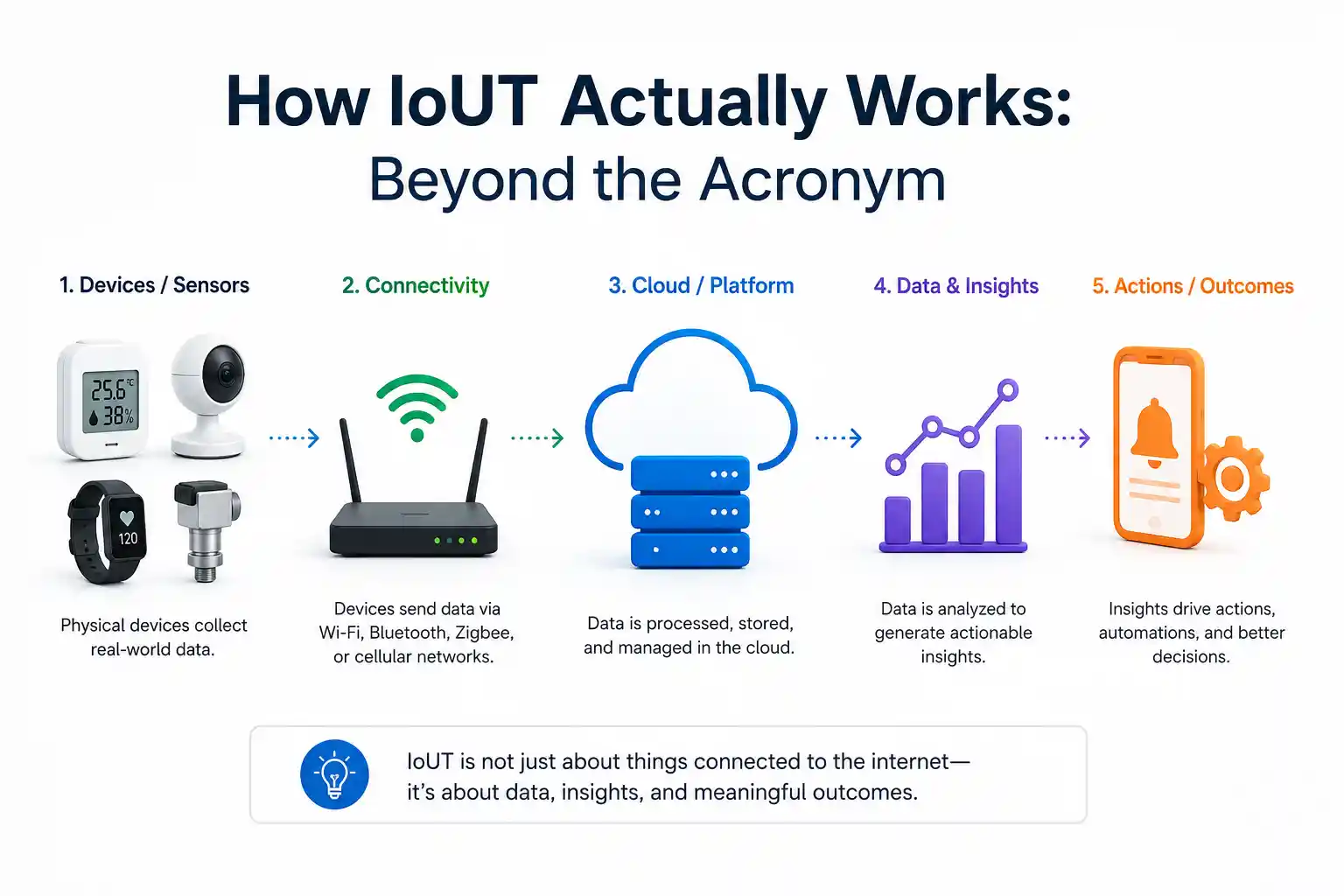
Acoustic Realities and Hardware Behavior Under Load
Manufacturers publish acoustic modem specifications in controlled wave tanks and quiet harbors. Real deployments meet turbidity, breaking internal waves, and the acoustic signature of a support vessel that hasn’t been acoustically quieted. I’ve watched commercial-grade subsea nodes perform flawlessly during commissioning in sheltered bays, then drop to single-digit packet success rates once deployed beyond the 50-meter contour. The hardware isn’t failing. The propagation environment is actively scattering the signal.
Biofouling doesn’t wait for scheduled maintenance windows. A clean transducer face on day one develops microorganism films within three weeks. Those films alter acoustic impedance, shift resonant frequencies, and introduce phase distortion that the demodulator interprets as corruption. Cleaning requires divers or ROV intervention. During high-current periods, you’re waiting for slack water. During winter, you’re waiting for the weather. Meanwhile, the dashboard keeps logging “Signal Degradation” while the operator watches fuel burn climb as the vessel holds station waiting for a clean acoustic window.
Installation logistics compound the problem. You can’t run fiber optic backhaul across open water without armored cabling, repeaters, and burial plows. Acoustic mesh networks look elegant on paper until you realize each node requires precise alignment for optical backups, stable mooring for consistent acoustic paths, and corrosion-resistant connectors that actually survive commercial marine environments. I’ve seen titanium housings hold up beautifully while the surrounding stainless-steel shackles pitted from galvanic corrosion. The node survived. The recovery rigging didn’t.
Operators adapt in ways that rarely appear in technical manuals. I’ve watched marine survey crews wrap acoustic transducers in temporary nylon sheathing during deployment to prevent snagging on kelp, then manually strip it once the node reached the bottom. I’ve seen technicians manually adjust modem transmit power mid-shift because a passing container ship was generating low-frequency rumble that drowned out the handshake sequence. These aren’t protocol violations. They’re field calibrations born from watching the system behave differently from the datasheet’s prediction.
The software interface rarely captures this messiness cleanly. A typical IoUT monitoring dashboard displays battery voltage, packet success rate, and sensor readings in tidy time-series graphs. It doesn’t show that the battery voltage dropped 0.3V during a cold water intrusion event, temporarily starving the power amplifier. It doesn’t show that the packet loss coincided with a fishing trawl passing overhead, scattering acoustic energy. The data is accurate. The context is missing. You have to read the operational logs, cross-reference sea state reports, and understand the local hydrography to make sense of what you’re looking at.
Simulated vs. Actual Deployment Testing
I ran a series of comparative tests using identical acoustic nodes deployed in a controlled estuary environment and an open coastal shelf site. The objective wasn’t to stress-test bandwidth. It was to measure how quickly environmental variables degraded telemetry reliability, and how operators adjusted when the system stopped behaving predictably.
In the estuary, the setup was straightforward. Depth held steady around six meters. Tidal currents ran predictably. Ambient noise stayed below 90 dB re 1 µPa. The acoustic mesh achieved 92% packet delivery over a 72-hour window. Battery drain matched specifications. The dashboard is populated with clean, continuous streams of salinity, turbidity, and current velocity data.
Move the same nodes to the coastal shelf, and the results fractured immediately. A passing storm system dropped barometric pressure, triggering surface wave generation that increased underwater noise by 15 dB. A shallow thermocline formed during daylight hours, bending the acoustic path upward and away from the receiver array. One node, mounted on a concrete reef ball, experienced localized vortex shedding from tidal flow, causing micro-vibrations that shifted the transducer alignment by half a degree. Packet delivery dropped to 41%.
The setup friction during testing was revealing. Calibrating gain levels required a diver in a full drysuit, tethered to a safety line, manually adjusting pre-amp settings while a deck winch operator fought crosswinds trying to hold the node at depth. Software latency didn’t help. The monitoring terminal displayed acoustic handshake attempts three to five seconds after they occurred, because the acoustic modem’s internal buffer was retrying failed transmissions before pushing data to the surface gateway. By the time the deck crew saw a “Failed Sync” alert, the modem had already attempted recovery twice. The delay wasn’t critical for long-term monitoring. It was disastrous for real-time ROV coordination.
I noticed that operator behavior shifted quickly once testing moved offshore. Instead of chasing 100% data recovery, crews started accepting probabilistic thresholds. They cross-checked acoustic readings with manual CTD casts. They ignored isolated packet drops when battery voltage remained stable. They logged environmental conditions alongside telemetry output, building a parallel dataset that explained what the dashboard couldn’t show. The testing didn’t produce a clean efficiency curve. It produced a map of where the system required human interpretation.
Who Actually Extracts Value, and Who Pays the Learning Tax
The operators who benefit from underwater telemetry networks aren’t reading vendor brochures. They’re the pipeline integrity engineers using continuous pressure and temperature logs to catch micro-leaks before they become emergency shutdown events. They’re the offshore wind developers monitoring scour protection around foundation monopiles, watching sediment shift patterns that traditional annual surveys miss. They’re coastal resource managers tracking reef restoration deployments where manual diver surveys are too slow and too expensive.
Smaller marine contractors struggle with the implementation curve. The barrier isn’t the hardware cost. It’s the operational discipline required to maintain a functional network. A commercial survey vessel charges thousands per day in standby time. If your acoustic nodes require firmware updates, you’re either pulling them to the surface or relying on low-bandwidth acoustic patching, which takes hours and fails if ambient noise spikes during the transfer window. That’s not a technical limitation. It’s a scheduling and budget reality that quickly compresses ROI projections.
Training burden scales with network complexity. You don’t need a PhD to deploy an IoUT node, but you do need someone who understands why transmit frequency selection matters when deploying in a noisy harbor, why acoustic shadow zones form behind steep underwater topography, and why a 1% clock drift between nodes ruins time-synchronized current profiling. That knowledge sits at the intersection of marine acoustics, embedded systems, and practical seafaring. It’s not taught in standard maritime certification courses. Operators learn it by watching data streams fail and backtracking through environmental logs.
Infrastructure requirements multiply quickly. Surface gateways need stable power, GPS synchronization, and clear acoustic coupling to the water. Subsurface relays require pressure-rated housings, anti-fouling coatings, and mooring lines that won’t chafe against hard seabed substrates. Backhaul connectivity depends on either satellite uplinks or cellular gateways within the coastal range. Each layer introduces a failure point, and each failure point demands a maintenance protocol that doesn’t exist in standard port maintenance schedules.
Deployment resistance comes from experienced hydrographers and marine engineers who have spent decades relying on proven survey methods. They aren’t anti-technology. They’re risk-aware. When a traditional multibeam sonar sweep produces a definitive seabed map, but a meshed sensor network produces probabilistic current estimates with intermittent dropouts, the choice isn’t about innovation. It’s about liability. You can’t submit a partially populated acoustic dataset to a classification society and expect it to pass structural certification review. The network works as an auxiliary monitoring layer. It doesn’t replace certified survey methodologies.
Shallow Water Chaos vs. Deep Water Silence
Coastal deployments behave differently from deep-water installations, and the differences aren’t just about depth. Shallow water is acoustically messy. Surface reflections, seabed scattering, vessel traffic noise, and tidal turbulence create a propagation environment that changes hourly. Multipath interference splits acoustic signals, causing the receiver to decode overlapping packet copies that corrupt the payload. You compensate by lowering transmission frequency, which reduces data rate and increases power consumption. It’s a constant trade-off.
Deep water offers cleaner acoustic channels. Sound travels further with less scattering when you’re below the surface mixing layer and above the deep-sea floor. But latency becomes a hard constraint. Acoustic signals move at roughly 1500 meters per second. A round-trip handshake to a node at 800 meters depth takes over a second before processing delays. Real-time control is physically impossible. You design for asynchronous data logging, buffered transmission, and delayed validation.
Commercial systems handle these environments with different engineering philosophies. Commercial-grade underwater nodes prioritize survivability: titanium or composite housings, redundant battery banks, wide-beam acoustic transducers that tolerate minor misalignment. They’re heavy, expensive, and require vessel cranes for deployment. Academic and prototype builds favor modularity: 3D-printed housings, interchangeable sensor boards, and narrow-beam transducers optimized for laboratory precision. They work beautifully in controlled environments. They fracture when exposed to commercial fishing gear, extreme currents, or months of continuous biological exposure.
Automated monitoring dashboards promise continuous oversight. Manual verification remains necessary. I’ve seen automated anomaly detection algorithms flag sudden pressure spikes as potential sensor failures. Dive inspection revealed actual pipeline settlement. The algorithm wasn’t wrong. It just lacked the operational context to distinguish between a hardware fault and a genuine structural event. The most reliable deployments pair automated telemetry with scheduled manual validation cycles, accepting that some discrepancies require boots on deck or eyes on a ROV camera feed.
Why Underwater Networking Resists Terrestrial Logic
Marine operational logic doesn’t translate to IT infrastructure. A server rack sits in a climate-controlled room with redundant power, structured cabling, and predictable thermal loads. A subsea sensor node sits at the bottom of a tidal channel, exposed to pressure fluctuations, temperature inversions, biological colonization, and mechanical stress from shifting sediment. The comparison isn’t useful. The design constraints are fundamentally different.
Communication reliability underwater depends on acoustic physics, not network architecture. You can’t increase bandwidth by adding more access points when every new node increases ambient noise and creates interference patterns. You manage it by scheduling transmission windows during low-traffic periods, selecting frequencies that avoid known noise signatures, and accepting that packet loss is a normal operating condition, not a failure state.
Hardware degradation accumulates invisibly. A minor O-ring compression set doesn’t leak immediately. It allows microscopic moisture ingress that slowly oxidizes contact pins. A slightly misaligned acoustic transducer doesn’t break. It just requires higher transmit power to achieve the same signal-to-noise ratio, draining battery capacity faster than the deployment model predicted. You don’t discover these issues during functional testing. You find them during year-two recovery operations, when you pull a node to the surface and realize the internal desiccant has been saturated for eighteen months.
Human workflow adaptation bridges the gap between technical specification and operational reality. Crews learn to read telemetry skeptically. They verify critical pressure readings against manual gauges. They ignore minor voltage fluctuations that fall within normal temperature compensation ranges. They schedule data pulls around vessel noise cycles, tidal windows, and weather forecasts. It’s inefficient on paper. It’s necessary in practice. Maritime engineering research from coastal monitoring programs consistently shows that successful underwater networks rely on operator experience, not automated optimization algorithms. NOAA coastal acoustic attenuation studies and IMO subsea monitoring guidelines reinforce the same conclusion: environmental variability demands human interpretation, not autonomous system control.
The maintenance impact compounds this reality. Every connection point, every pressure seal, every acoustic interface requires inspection. You don’t just swap out a failed sensor. You mobilize a vessel, stage recovery equipment, coordinate with port authorities, and wait for a weather window. The downtime cost often exceeds the hardware replacement value. You design for longevity because failure isn’t a quick fix. It’s a logistical operation.
Documented Friction Points
The friction accumulates in the bilge and on the screen. It’s rarely dramatic. It’s persistent.
Corrosion doesn’t announce itself with catastrophic failure. It exploits every unsealed thread, every dissimilar metal junction, every sacrificial anode that depletes faster than predicted in high-current environments. Titanium housings survive. The stainless-steel quick-release shackles don’t. You learn to inspect rigging hardware before deployment, not after.
Maintenance burden scales non-linearly with network size. A three-node deployment requires quarterly surface recovery, transducer cleaning, firmware verification, and battery health logging. Expand to twelve nodes, and you’re managing staggered deployment cycles, mooring line inspections, and acoustic path recalibration as vessels and currents shift node positions. The dashboard shows “Network Healthy.” The maintenance log shows three overdue inspections and one node drifting out of acoustic range due to sediment scour.
Inconsistent tracking emerges when nodes don’t stay put. Bottom currents migrate sensor arrays. Scour around foundation structures changes local topography. Mooring lines stretch under cyclical loading. The software assumes fixed coordinates. The reality is dynamic. Operators compensate by running periodic positioning verification using acoustic triangulation or ROV-mounted USBL systems, adding hours to routine data collection cycles.
Dashboard clutter becomes an operational hazard during multi-parameter deployments. You’re scrolling through real-time current profiles, dissolved oxygen readings, acoustic signal strength, battery voltage curves, and acoustic modem retry counters. The interface doesn’t fail. It just demands more cognitive bandwidth than a single watchstander can reasonably spare during heavy weather or vessel maneuvering.
Weather interference isn’t a software exception. It’s a deployment reality. High sea states delay node deployment and recovery. Wind-driven surface noise masks acoustic handshakes. Precipitation changes surface acoustic coupling, temporarily degrading gateway-to-node communication. You don’t troubleshoot this with IT protocols. You wait for the weather window.
Unreliable updates compound operational friction. Firmware patches delivered over acoustic links require extended handshake sequences that fail if ambient noise spikes mid-transfer. I’ve watched technicians retry a patch four times over two days, manually coordinating vessel thruster shutdowns and monitoring acoustic noise levels, before finally completing a 12-kilobyte update. The system works. The process is exhausting.
Software usability frustrations persist. Monitoring interfaces are frequently designed by embedded systems engineers who prioritize data completeness over operational clarity. Alert thresholds default to factory settings that trigger on minor environmental fluctuations. Data export formats don’t align with commercial hydrographic reporting standards. Operators spend more time reformatting datasets than interpreting them.
Installation delays rarely come from missing components. They come from vessel scheduling conflicts, crane availability, mooring substrate assessment, and acoustic path validation surveys that reveal unexpected underwater obstructions. You can’t rush deployment when a fishing vessel’s anchor line crosses your planned acoustic corridor. You adapt, re-route, and accept the schedule slip.
Sensor degradation follows predictable but variable timelines. Turbidity sensors accumulate biological film within weeks, requiring cleaning or recalibration. Pressure transducers drift under prolonged deep-water deployment, especially when subjected to temperature cycling. Acoustic modems experience gradual power amplifier degradation that reduces maximum effective range by ten to fifteen percent per operational year. You compensate with scheduled maintenance, but you never return to day-one baseline performance.
The operator learning curve is steep because it demands interdisciplinary competence. You need to understand marine acoustics, embedded hardware diagnostics, network troubleshooting, hydrographic survey methodologies, and vessel operations. You don’t learn that in a vendor certification course. You learn it by troubleshooting failed deployments in cold water, reading acoustic noise spectra, and cross-referencing telemetry anomalies with environmental logs.
The Practical Compromise
Underwater telemetry networks deliver value, but not the kind that fits neatly into a vendor’s integration diagram. The returns come from incremental improvements: earlier leak detection, reduced ROV survey frequency, and continuous environmental baseline data. These gains compound over the years, but they require sustained operational discipline to capture.
The teams that succeed treat IoUT deployment as a continuous adaptation cycle. They budget for recurring recovery operations. They train crews to read acoustic data contextually, not just numerically. They accept that some nodes will underperform during high-noise periods, and they build redundancy into critical monitoring paths. They don’t chase perfect data streams. They build tolerance for environmental noise and layer verification protocols that compensate for acoustic uncertainty.
Technology doesn’t replace marine expertise. It extends it. It provides continuous monitoring where manual surveys are too slow or too dangerous. It generates datasets that reveal long-term environmental trends and structural wear patterns. But it doesn’t eliminate the need for operators who understand how saltwater behaves, how acoustic signals propagate, and how to read a dashboard skeptically when the numbers don’t match the sea state.
The most reliable underwater networks aren’t the ones with the highest packet success rates in controlled testing. They’re the ones deployed by teams who know exactly where the acoustic shadow zones form, who schedule maintenance around tidal windows, and who treat data anomalies as environmental artifacts until proven otherwise. The ocean doesn’t optimize for network architecture. It operates on physical constraints that demand respect, not workaround. The smart marine systems that endure are the ones designed to accommodate that reality, not override it.
About Writer: Howard Craven writes about offshore maintenance systems, vessel operations, and marine infrastructure workflows, focusing on how environmental conditions affect real-world deployment reliability.