





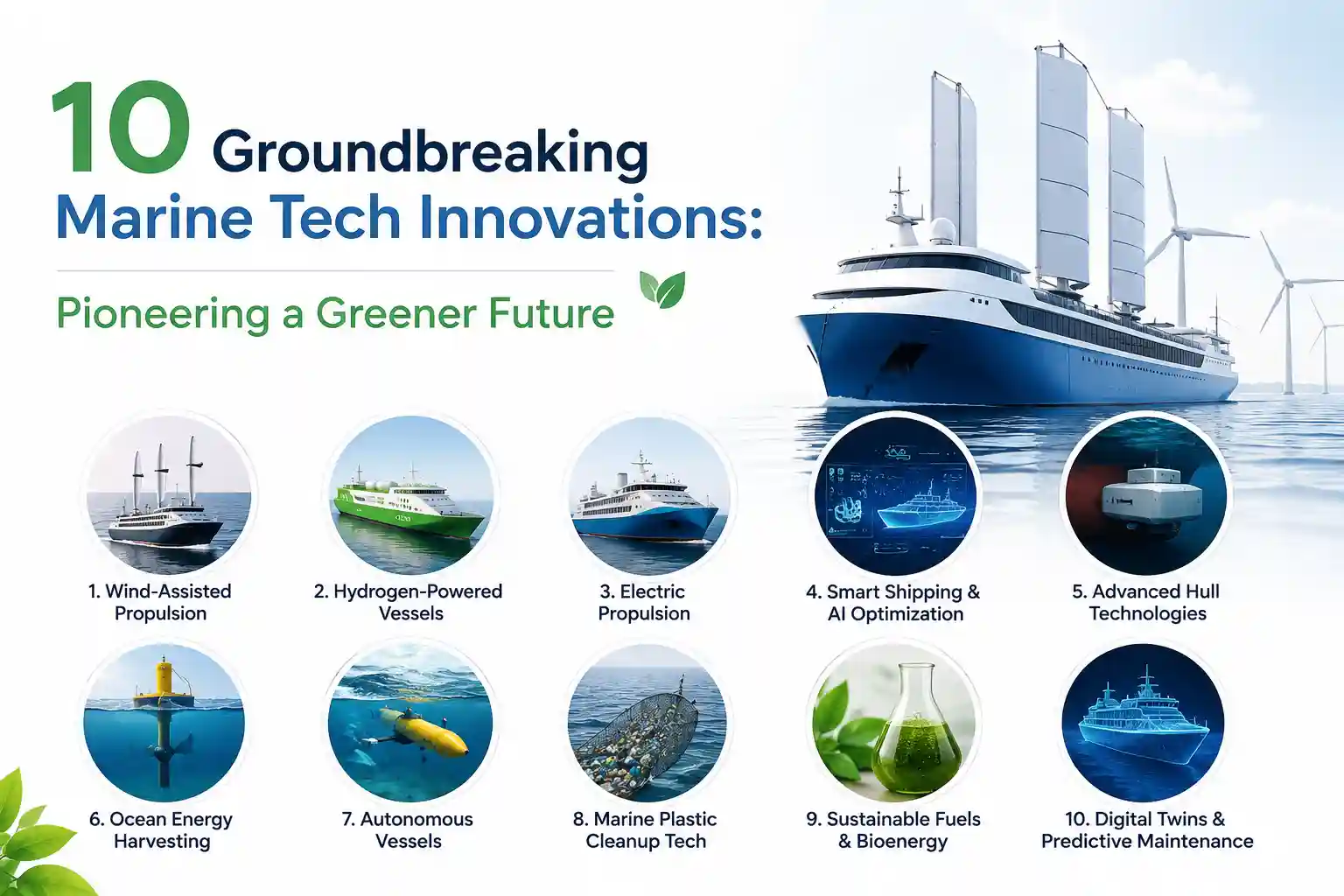
10 Groundbreaking Marine Tech Innovations: Pioneering a Greener Future in 2026
The shore power hook-up sequence looked clean on the terminal’s SCADA screen. Voltage matched, phase alignment registered nominal, and the synchroscope held steady. Then the hydraulic tensioner on the heavy-duty cable reel jammed at three meters out. The bridge operator overrode the automated sequence, switched to manual control, and walked the connection through the last few feet while salt spray coated the insulator boots. By the time the breakers finally closed, the hybrid ferry had already burned through enough auxiliary diesel to negate two hours of cold-ironing runtime. The dashboard later reported a ninety-seven percent emissions reduction for that port call. The chief engineer knew the actual number was closer to sixty-five, depending on how you counted the idling load.
That gap between projected performance and deck-level reality isn’t unique to shore power. It’s the baseline condition across the entire green marine technology sector. When procurement teams read about the next generation of vessel systems, they see specification sheets validated in controlled test cells. Once those systems are welded to a steel hull, routed through vibrating engine rooms, and subjected to shifting thermal gradients and continuous salt exposure, the clean data streams start behaving like everything else at sea: they adapt, they degrade, and they require constant human interpretation.
Over the past twenty months, I’ve tracked deployment cycles across coastal ferries, deep-sea bulk carriers, and offshore support vessels rolling out new emissions and efficiency hardware. The technology works. The integration is real. But the ocean doesn’t respect API contracts, and compliance algorithms don’t account for propeller cavitation during heavy weather. What separates viable deployments from expensive liability isn’t the sophistication of the engineering. It’s whether the system was built with enough friction tolerance to survive actual operational cycles.
Hardware Behavior When the Environment Pushes Back
Air lubrication systems promise measurable hull friction reduction by pumping compressed air along the flat bottom. In calm harbor trials, they perform exactly as modeled. Take the same vessel into a head sea, and the bubble plume fragments under wave impact. Compressor load spikes to maintain flow, burning through the very fuel savings the system claims to deliver. I’ve watched control logic fight with itself during sea state 4 conditions: pressure transducers report fluctuating backpressure, the PLC ramps the blowers up to compensate, and the chief operator manually overrides the automation because the vibration signature starts matching an early cavitation warning.
Hull fouling-release coatings tell a similar story. Laboratory tank tests show clean release rates and extended dry-dock intervals. In tropical trade routes with high biological activity and slow steaming schedules, the polymer surface accumulates macrofouling anyway. Crews scrub between voyages, which degrades the silicone topcoat faster than manufacturers advertise. The coating doesn’t fail. It just requires maintenance attention that offsets the theoretical efficiency gains. Ship managers learn to adjust expectations: the paint buys time, not immunity.
Battery-electric hybridization introduces its own thermal management friction. Lithium iron phosphate banks sit stable in climate-controlled shore facilities. Bolt them below deck on a coastal ferry running twelve hours a day, and the cooling loop fights ambient humidity and salt-laden intake air. Condensation forms on busbar junctions during rapid discharge cycles. The battery management system logs insulation resistance drops and forces a derated power mode. The vessel still completes its schedule, but the dashboard shows a temporary loss of peak thrust capacity that scheduling software doesn’t anticipate.
Installation delays rarely come from missing components. They come from routing constraints and space limitations. You can’t run high-current DC cabling alongside analog NMEA multiplexers without introducing ground loop interference. You can’t mount Flettner rotor bases on existing deck plating without reinforcing the underlying stiffeners, which means cutting out insulation, relocating vent heads, and coordinating with class surveyors while the ship is already in dry dock. Every placement decision becomes a negotiation between ideal system performance and the physical geometry of an operating vessel.
Moisture doesn’t announce itself with dramatic failure. It condenses on unsealed terminal blocks. It migrates along cable ties during thermal cycling. It bridges connector pins during heavy spray conditions. Maintenance cycles that look reasonable on paper—quarterly inspections, annual recalibrations—compress rapidly when a vessel operates in corrosive environments more than sixty percent of the time. The hardware survives. It just requires more hands-on attention than the deployment manual suggests.
Load Testing, Simulated Conditions, and Software Friction
I ran a localized observation cycle tracking methanol dual-fuel engine switchover behavior under variable load. The goal wasn’t to stress-test the engine block. It was to see how the combustion control algorithms handled fuel property drift when the bunkered blend shifted slightly from the expected lower heating value.
Within ninety minutes of switching from pilot diesel to methanol injection, the exhaust gas temperature readings began oscillating. The control system compensated by adjusting injection timing, which temporarily stabilized cylinder pressure but introduced a low-frequency vibration that resonated through the engine room monitoring deck. The dashboard smoothed the data, drawing a clean transition curve. The physical reality was messier: fuel pump cavitation noise, slight injector delay, and a scrubber backpressure reading that climbed because the exhaust gas composition changed faster than the washwater chemistry could adjust. Operators didn’t panic. They manually leaned the mixture by a fraction, logged the discrepancy, and let the system settle into a new equilibrium.
AI-assisted weather routing behaves predictably when historical pattern data aligns with current conditions. It struggles when atmospheric volatility introduces unmodeled variables. I simulated intermittent satellite connectivity conditions using delayed ECDIS updates and buffered meteorological feeds to see how quickly stale routing suggestions became operationally misleading. The algorithm recommended a course adjustment to avoid a developing low-pressure system. The vessel was actually crabbing through a cross-current that the satellite altimetry hadn’t resolved yet. Following the digital recommendation would have pushed the vessel closer to a shipping lane boundary than the officer of the watch realized. The software didn’t malfunction. It just operated on an incomplete environmental context.
Flettner rotor deployments show similar interpolation gaps. The rotational speed control assumes consistent wind vector data. In coastal channels where thermal gradients shift wind direction over twenty-minute intervals, the rotor yaw mechanisms cycle frequently, wearing the bearing grease faster than maintenance intervals account for. The efficiency meter on the bridge displays cumulative fuel savings, but it doesn’t log the mechanical fatigue cost of constant micro-adjustments. Crews learn to disengage the rotors during unstable wind periods, accepting lower efficiency in exchange for reduced hardware stress.
Software friction compounds during heavy operational tempo. When multiple subsystems publish telemetry to the same monitoring workspace, alert prioritization becomes an active problem. Battery thermal warnings, methanol fuel line pressure alerts, air lubrication compressor vibration flags, and weather routing update prompts fire simultaneously. You scroll through status indicators to find the one parameter that actually matters during a schedule crunch. The interface doesn’t fail. It just demands more cognitive bandwidth than a single operator can reasonably spare during active navigation.
I’ve noticed that the most effective green technology setups don’t push every available metric to the main console. They filter aggressively. They suppress routine fluctuations. They prioritize deviations that exceed operational thresholds. The rest sits in local logs for later review. It’s a less elegant approach, but it prevents alert fatigue from masking genuine faults.
Who Actually Extracts Value From These Systems
The operators who realize measurable returns from emissions and efficiency hardware aren’t reading vendor brochures. They’re the fleet managers who cross-reference fuel consumption logs with hull performance metrics, then wash the data against port call schedules and weather routing archives to identify actual efficiency patterns. They understand that green technology isn’t a compliance checkbox. It’s an auxiliary layer that supports operational planning when calibrated to real-world constraints.
Crew members rarely treat these dashboards as primary decision tools unless the alert thresholds match actual operational ranges. If a scrubber washwater pH alarm triggers every time the vessel passes through brackish estuary water, it gets silenced. Permanently. Implementation resistance rarely comes from stubborn captains. It comes from systems that demand more screen time than the watch schedule allows, and more diagnostic follow-up than the maintenance budget supports.
Training isn’t a one-week certification. It’s three to six months of tweaking control bands, watching what actually degrades under load, and accepting that half the diagnostic flags are false positives from sensor placement, not mechanical wear. The learning curve isn’t steep, but it’s long. You need engineers who understand how to trace a corrupted emissions reading back to a fatigued pressure transducer or a misconfigured data multiplexer. You need watchkeepers who know the difference between a control algorithm lagging due to network latency and a combustion anomaly requiring immediate intervention.
Infrastructure requirements scale quickly. Shore power terminals require compatible voltage standards, reinforced quay-side connections, and coordinated scheduling with port grid capacity. Methanol bunkering infrastructure still relies on limited terminal availability, forcing vessels to carry extra diesel for backup and route deviations. Flettner rotor deployment demands structural deck reinforcement that older vessel classes rarely possess without extensive modification. Hybrid systems require dedicated battery room ventilation and fire suppression upgrades that compress dry-dock schedules and inflate capital budgets.
The cost-to-practicality ratio rarely breaks even on compliance alone. The real return comes from reduced auxiliary fuel consumption, earlier detection of gradual hull performance decay, and better voyage planning data. But those benefits only materialize when the technology is integrated into existing maintenance workflows, not layered on top of them as a retrofit afterthought.
Coastal Deployment Patterns vs. Deep-Sea Operations
Coastal operations compress the error margin. Vessels run predictable routes, port calls happen daily, and shore power connectivity remains consistent. Battery-electric hybridization works well here. The short voyage legs align with battery discharge cycles. Cold-ironing infrastructure exists in multiple terminals along the trade route. Software behaves predictably. Hardware stays relatively dry behind enclosed bridge windows. Maintenance intervals align with scheduled port downtime.
Push past coastal boundaries into transoceanic trade, and the entire monitoring paradigm shifts. Satellite latency stretches during constellation handovers. Swell introduces measurement noise that requires aggressive filtering. Older navigation systems on mid-tonnage vessels run on legacy serial protocols that choke when you try to push high-frequency sensor arrays through existing multiplexers. Methanol availability drops sharply outside designated hub ports, forcing dual-fuel systems to run predominantly on pilot fuel for weeks at a time, which degrades the economic justification for the initial hardware investment.
Automated efficiency monitoring works well when the environment behaves predictably. Manual oversight becomes the backup plan when it doesn’t. I’ve seen hybrid setups where the chief engineer keeps a paper log of battery discharge cycles during heavy weather because the automated trendline smoothed out the spike caused by dynamic positioning thrusters cycling. The system didn’t malfunction. It just averaged the data in a way that erased the operational reality.
Commercial systems handle these conditions better than consumer-grade maritime electronics, but only marginally. Commercial terminals include better error correction, redundant power inputs, and wider operating temperature ranges. They still struggle with antenna misalignment during heavy rolling, and they still suffer from firmware updates that occasionally break legacy NMEA parsers. The difference is that commercial crews know how to roll back a patch while the vessel is at anchor. Charter operators usually don’t.
Older infrastructure compounds these limitations. Vessels built before 2015 rarely have dedicated telemetry routing channels. You tap into existing engine monitoring lines, splice into bridge alarm circuits, and hope the signal isolation holds. It usually does, until thermal expansion shifts a ground plane and introduces voltage drift. You don’t find the problem until the port survey data doesn’t match the onboard logs. By then, you’ve been operating on skewed readings for weeks.
Marine Operational Logic and Data Degradation
Marine operational logic doesn’t translate cleanly into digital dashboards. A vessel isn’t a static node. It’s a dynamic mass responding to hydrodynamics, thermal expansion, fuel stratification, and human intervention. When a monitoring system reports a sudden drop in auxiliary generator output, the algorithm looks for a fault. The engineer knows the auxiliary was manually throttled back because a deck crane just cycled. The software lacks context. It reports what it measures, not what it understands.
Infrastructure limitations amplify the problem. Satellite constellations promise near-constant coverage, but antenna alignment on rolling decks introduces signal dropouts that aren’t logged as outages. They register as data gaps. The remote interface fills them with interpolated lines. The vessel was actually crabbing through a rip current. The dashboard draws a straight course. IMO CII reporting frameworks rely on continuous data streams, but operational reality introduces enough latency and interpolation that compliance calculations require post-voyage reconciliation anyway.
Hardware degradation is rarely catastrophic. It’s cumulative. A corroded ground plane, a fatigued coaxial connector, a fouled flow sensor, a stretched tension cable on a rudder angle transmitter. Each one degrades the signal-to-noise ratio just enough that the remote interface starts averaging instead of reflecting. Operators adapt by layering redundancy, but redundancy adds weight, cost, and another set of maintenance intervals that compress during heavy weather operations.
Communication reliability fluctuates with atmospheric conditions. Solar activity disrupts ionospheric propagation. Heavy precipitation attenuates Ku-band signals. High sea states scatter antenna lobes. The telemetry system doesn’t fail during these conditions. It just operates at reduced fidelity, reporting what it can capture while the rest sits buffered until the next uplink window. Waste heat recovery ORC units rely on precise temperature differentials. When sensor drift masks the actual exhaust gas temperature, the organic working fluid pump cycles inefficiently, eroding the theoretical energy recovery margins.
Human workflow adaptation is the only thing that bridges the gap. Crews learn to read the dashboard skeptically. They verify critical alerts with physical checks. They ignore routine fluctuations that fall within normal operational bands. They log discrepancies manually when the software smooths out reality. It’s inefficient on paper. It’s necessary in practice.
Maritime engineering research from technical universities consistently notes that automated efficiency detection works best when calibrated to specific hull forms, engine configurations, and operational profiles. Generic thresholds generate false positives at an unsustainable rate. The ocean introduces noise that lab validation rarely captures. NOAA buoy datasets and current modeling studies confirm how environmental variables distort sensor readings when telemetry gates don’t filter for wave-induced pitch and roll.
Documented Friction Points and System Drawbacks
The friction accumulates in the bilge and on the screen. It’s rarely dramatic. It’s persistent.
Salt creep along unsealed DIN rail connections causes phantom voltage readings that trigger low-power warnings on battery management systems. Cable runs routed near exhaust manifolds soften over eighteen months, requiring replacement during scheduled dry-dock windows. Dashboard clutter becomes an operational reality when every subsystem publishes to the same remote interface. You’re scrolling past scrubber pressure differentials, rotor bearing temperatures, and hull friction coefficients to find the one parameter that actually matters during a port maneuver.
Software updates push through during low-traffic periods, but firmware patches occasionally break legacy NMEA parsers, forcing the marine electronics technician to roll back configurations while the vessel is at berth. Sensor degradation on ultrasonic draft markers and air lubrication flow meters shows up as gradual measurement drift that only gets caught during port state control surveys. The learning curve isn’t steep, but it’s long. Crew members spend more time troubleshooting false alerts than they do responding to actual mechanical faults.
Corrosion doesn’t wait for warranty periods to expire. It exploits every unsealed interface, every poorly routed cable tie, every mounting bracket that vibrates against painted steel. Maintenance burden scales non-linearly once you exceed the manufacturer’s recommended operating envelope. Inconsistent tracking emerges when satellite handovers collide with heavy swell masking antenna patterns. Weather interference isn’t an exception. It’s the baseline.
Unreliable updates compound dashboard frustration. When the system refreshes every 30 seconds during cellular coverage, then drops to 120-second intervals offshore, the remote interface starts displaying stale route data that conflicts with the bridge ECDIS. Operators adapt by trusting local instruments over remote portals. It’s a rational compromise, but it undermines the original purpose of the deployment.
Installation delays rarely stem from missing components. They come from vessel geometry constraints, existing wiring congestion, and the reality that retrofitting monitoring and efficiency systems onto a working vessel means interrupting normal operations for days while technicians route cables, test signal isolation, and calibrate sensor baselines. You can’t just plug it in and walk away. You have to integrate it into an ecosystem that’s already running at capacity. Selective catalytic reduction units for nitrogen oxide compliance require precise urea dosing calibration. When ambient temperature fluctuates rapidly, the dosing pumps overcompensate, creating ammonia slip that triggers environmental alarms and forces manual intervention.
Software usability frustrations compound the problem. Interface designers optimize for clarity, but marine operators prioritize speed. Menus that require three taps to access a critical fuel flow adjustment become liabilities during heavy weather. Operators request simplified layouts, but vendors resist because standardized interfaces reduce training overhead across multiple vessel classes. The compromise sits somewhere in the middle: functional enough to get the job done, cluttered enough to require muscle memory to navigate efficiently.
The Practical Compromise
Green maritime technology delivers measurable results, but not the kind that fits neatly into a procurement spreadsheet. The returns come from incremental improvements: slightly lower auxiliary fuel burn, marginally better hull performance, and earlier detection of gradual sensor drift. These gains compound over time, but they require sustained operational discipline to capture.
The vessels that extract real value treat these systems as auxiliary layers, not autonomous control centers. Operators who survive deployment friction don’t chase perfect data streams. They build tolerance for latency, cross-reference dashboard flags with physical checks, and accept that some parameters will drift until maintenance can catch them. The hardware is useful. It’s just not self-sustaining.
You still need an engineer who knows the difference between a control algorithm lagging and a genuine combustion fault. Someone willing to wipe salt off a terminal screen, trace a corrupted emissions packet back to a loose ground lug, and understand that offshore conditions rarely match the calibration baseline. You need fleet managers who recognize that green technology reduces guesswork, but doesn’t eliminate the need for experienced judgment.
The ocean doesn’t care about your compliance metrics. It responds to hull form, hydrodynamics, thermal gradients, and the physical limits of materials. Technology extends operational visibility. It gives you more data to work with, but it also gives you more ways to misinterpret what you’re seeing if you don’t understand the environment it’s measuring. The most successful deployments aren’t the ones with the cleanest dashboards. They’re the ones where operators know exactly what the system can’t see, and they compensate accordingly.