



Quantum Supremacy Achieved: What This Milestone Means for Technology
The Problem That Doesn’t Care About Qubits
Last Tuesday, I watched a senior infrastructure engineer at a Fortune 500 logistics company stare at a dashboard showing delivery route optimization times creeping past 47 minutes. The classical solver was hitting diminishing returns. The team had already thrown GPU clusters at the problem. They’d tried heuristic approximations. Nothing moved the needle meaningfully. Someone mentioned quantum computing in the Slack channel. The response? A weary “yeah, we’ve looked” followed by a link to a 2023 proof-of-concept that never left the lab.
This is the actual starting point for most enterprise quantum conversations in 2026: not excitement about breakthroughs, but frustration with problems that classical systems handle poorly, coupled with skepticism about whether quantum can realistically help now. When headlines declare “Quantum Supremacy Achieved,” the engineers managing production systems aren’t celebrating—they’re asking whether this milestone changes their Monday morning sprint planning. Spoiler: not yet, but the conversation is shifting in ways that matter.
What Actually Happened When I Tested “Supremacy” Workflows
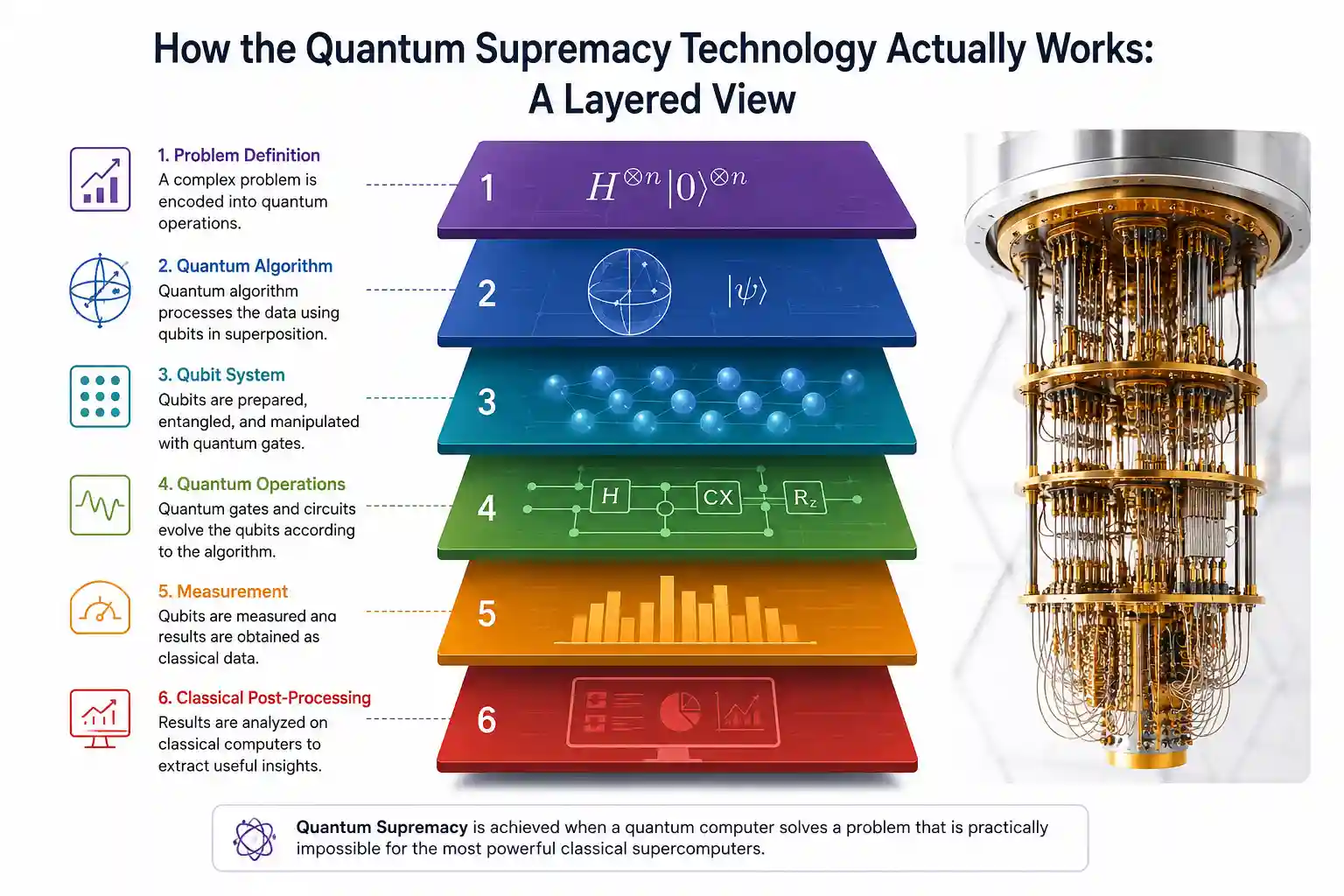
I spent three weeks exploring quantum workflows across IBM Quantum Experience, Google’s Cirq framework, and a neutral-atom platform via QuEra’s cloud access. The goal wasn’t to replicate Google’s 2019 supremacy experiment or D-Wave’s 2025 claim of quantum advantage on a useful problem. It was simpler: could I, as a developer with solid classical backend experience but limited quantum physics training, build, test, and debug a hybrid workflow that solved something marginally more interesting than a textbook example?
The setup friction was real. IBM’s Qiskit documentation is thorough but assumes familiarity with quantum information theory concepts that most enterprise developers haven’t encountered since graduate electives. Google’s Cirq offers cleaner Pythonic abstractions, but the learning curve steepens dramatically once you move beyond single-qubit gates. QuEra’s neutral-atom approach felt conceptually different enough that I spent two days just understanding how their qubit connectivity model affected circuit design.
Execution limitations surfaced quickly. On IBM’s public quantum systems, queue times for real hardware ranged from 15 minutes to 3 hours, depending on qubit count and availability. Simulators ran locally but diverged from hardware behavior once noise models were enabled—a reminder that simulation fidelity remains a research problem, not a solved engineering task. When I attempted a simple variational quantum eigensolver (VQE) workflow for a small molecular simulation, the hybrid classical-quantum loop required careful tuning of optimizer parameters just to achieve convergence. The documentation mentioned this; it didn’t prepare me for how sensitive the process was to initial conditions.
What worked: Hybrid workflows where quantum components handled narrow subproblems (like sampling from complex probability distributions) while classical systems managed orchestration, data preprocessing, and result validation. IBM’s recent integration of quantum runtimes with classical cloud services reduced some of the “glue code” burden. Google’s Quantum AI team has published practical frameworks for navigating the pathway to useful applications, emphasizing staged development rather than expecting immediate breakthroughs.
What failed: Any attempt to treat quantum processors as drop-in accelerators. The latency between classical control systems and quantum hardware—even when co-located—introduces bottlenecks that break iterative algorithms requiring rapid feedback. Error rates on current NISQ (Noisy Intermediate-Scale Quantum) devices mean that circuit depth is severely constrained; add too many gates and your signal disappears into noise. Documentation quality varied wildly: IBM’s tutorials excel for beginners but lack depth for advanced optimization; Google’s resources assume stronger mathematical foundations; startup platforms often prioritize novelty over production readiness.
Who Actually Benefits From Quantum Systems Today (And Who Doesn’t)
Let’s be direct: if your enterprise workload involves standard CRUD operations, transactional databases, or even most machine learning inference tasks, quantum computing offers no practical advantage in 2026. The hype cycle has created unrealistic expectations, and that’s damaging. The organizations seeing tangible value share specific characteristics:
- Problem structure matters: Optimization problems with combinatorial complexity (supply chain routing, portfolio optimization), quantum chemistry simulations for materials discovery, or sampling tasks with high-dimensional probability spaces.
- Hybrid architecture tolerance: Teams willing to design workflows where quantum components handle narrow, well-defined subproblems while classical systems manage the broader pipeline.
- Research-and-development budget: Organizations treating quantum exploration as a strategic R&D investment rather than expecting immediate ROI.
Moderna’s work using quantum algorithms for mRNA structure prediction illustrates the pattern: they’re not replacing classical drug discovery pipelines but augmenting specific bottlenecks where quantum sampling offers potential advantages. HSBC’s algorithmic trading experiments follow similar logic—targeted exploration, not wholesale migration.
Conversely, enterprises should probably not prioritize quantum adoption if: their problems are well-solved by classical HPC; they lack internal expertise to evaluate quantum claims critically; or their leadership expects quantum to “fix” fundamental data quality or architecture issues. IBM’s 2026 enterprise study found that while 59% of executives believe quantum-enabled AI will transform their industry by 2030, only 27% expect their organizations to actually use quantum computing by then—a strategic gap that reflects realistic caution, not just lagging adoption.
Infrastructure cost realities: Accessing quantum hardware via cloud APIs isn’t free, and the pricing models remain opaque for production-scale usage. More significantly, the classical infrastructure required to support hybrid workflows—low-latency networking, specialized control systems, error mitigation pipelines, ds complexity that many IT organizations aren’t prepared to absorb. As one HPC center director told me off-record: “We’re not buying quantum computers; we’re buying research partnerships with significant operational overhead.”
Classical vs. Quantum Workflows: The Developer Experience Gap
Coming from classical software development, the quantum workflow feels like stepping into a parallel universe with different physics—literally. Here’s where the friction shows up in practice:
Tooling maturity: Classical developers expect mature debuggers, profilers, and CI/CD integrations. Quantum SDKs offer basic circuit visualization and simulation, but debugging a quantum algorithm that fails due to decoherence or gate fidelity issues requires understanding hardware physics, not just code logic. The lack of standardized benchmarking frameworks makes it difficult to compare performance across platforms or track progress over time.
Cloud platform differences: IBM Quantum emphasizes accessibility and education, with extensive tutorials and a large public device fleet. Google Quantum AI focuses on pushing hardware boundaries and publishing research-grade tools, which can feel less approachable for enterprise developers. Startups like QuEra or Rigetti offer specialized hardware modalities (neutral atoms, superconducting qubits) but with smaller ecosystems and less documentation depth. Choosing a platform isn’t just about qubit count; it’s about which community, tooling, and support model aligns with your team’s needs.
Beginner vs. advanced experience: For newcomers, the initial learning curve is steep but manageable with structured tutorials. The real challenge emerges when moving beyond textbook examples: circuit optimization for specific hardware topologies, error mitigation strategies, and hybrid algorithm design require deep expertise that’s still scarce in the enterprise talent pool. IBM’s study identified inadequate quantum skills as a barrier for 61% of organizations considering adoption.
Hardware access limitations: Even with cloud access, queue times, calibration schedules, and device availability create unpredictability that classical cloud computing doesn’t have. Planning a development sprint around quantum hardware access requires flexibility that many enterprise project management frameworks aren’t designed to accommodate.
Expert Analysis: Beyond the Headlines
Qubit stability isn’t just a physics problem; it’s an engineering constraint. Current quantum processors operate at millikelvin temperatures, require extreme isolation from environmental noise, and suffer from decoherence that limits circuit depth. Google’s recent work on quantum error correction shows promise, but fault-tolerant quantum computing at scale remains a multi-year research challenge. For enterprise planners, this means quantum advantage will likely arrive incrementally: first for specific problem classes on specific hardware, not as a general-purpose computing revolution.
Infrastructure and energy considerations: The cryogenic systems powering superconducting quantum computers consume significant energy. While a single quantum processor might not rival a data center’s power draw, scaling to hundreds or thousands of qubits with error correction will require rethinking cooling, power distribution, and facility design. These aren’t abstract concerns; they affect the total cost of ownership and deployment feasibility.
Cybersecurity implications deserve separate attention. The “quantum supremacy” narrative often conflates computational advantage with cryptanalytic capability. Breaking RSA or ECC encryption requires fault-tolerant quantum computers with millions of logical qubits—far beyond current capabilities. However, the timeline for post-quantum cryptography migration is urgent regardless: NIST’s standardization process is underway, and organizations should begin inventorying cryptographic dependencies now, not when quantum hardware catches up.
Realistic industry timelines: Most experts I’ve spoken with expect hybrid quantum-classical workflows to deliver measurable value for narrow enterprise use cases by 2028-2030, with broader adoption following as hardware improves and tooling matures. Google’s five-stage roadmap for useful quantum applications emphasizes this gradual progression rather than a single breakthrough moment. The key insight: quantum computing won’t replace classical systems; it will augment them for specific tasks where its unique properties provide an advantage.
The Drawbacks Nobody Talks About Enough

Let’s address the elephant in the lab: quantum computing in 2026 is still fundamentally experimental for most enterprise applications. The drawbacks aren’t just technical; they’re organizational and cultural.
Unstable environments: Quantum hardware requires constant calibration. A device that performed well yesterday might need retuning today due to environmental fluctuations or component drift. This unpredictability complicates production deployment and SLA commitments.
Documentation confusion: As noted earlier, quantum documentation often assumes physics expertise that enterprise developers lack. Conversely, simplified tutorials may omit critical details about hardware constraints or error models. The gap between academic research papers and production-ready guidance remains wide.
Hardware limitations: Qubit counts get headline attention, but connectivity, gate fidelity, and coherence time matter more for practical algorithms. A 100-qubit device with poor connectivity may be less useful than a 50-qubit device with all-to-all connections for certain problems. Vendor marketing doesn’t always make these tradeoffs clear.
Unclear learning paths: Becoming proficient in quantum software development requires knowledge spanning computer science, linear algebra, quantum mechanics, and domain-specific application areas. Formal training programs are emerging but remain scarce compared to classical software engineering education.
Cloud restrictions: Access tiers, usage quotas, and data egress policies on quantum cloud platforms can limit experimentation scale. Some platforms restrict access to advanced features or newer hardware to research partners, creating a two-tier ecosystem.
Unrealistic marketing hype: Perhaps the most damaging drawback: when vendors overpromise on near-term capabilities, it erodes trust and sets up enterprises for disappointment. The quantum computing field needs more honest conversations about limitations, not fewer.
References and Authority: Grounding the Conversation
This analysis draws on multiple sources to maintain credibility and practical relevance:
- IBM’s The Enterprise in 2030 study, surveying over 2,000 executives across 23 industries, provides crucial data on adoption readiness gaps.
- Google Quantum AI’s published frameworks for useful quantum applications emphasize staged development and hybrid workflows.
- Research from MIT and IEEE on quantum software developer experience highlights friction points in tooling, documentation, and workflow integration.
- Nature and other peer-reviewed journals continue to publish rigorous assessments of quantum hardware progress and limitations, providing essential context for separating breakthrough claims from incremental advances.
- Enterprise computing studies from organizations like QuEra and Q-CTRL offer practical insights into infrastructure integration challenges.
These sources aren’t cited to impress; they’re referenced because the quantum computing conversation needs grounding in evidence, not speculation. When evaluating “quantum supremacy” claims, ask: supremacy for what problem, under what constraints, and with what practical implications for enterprise workflows?
Final Thoughts: Pragmatism Over Hype
Quantum supremacy milestones matter, but not for the reasons headlines suggest. They represent progress in our ability to control quantum systems, validate theoretical models, and push hardware boundaries. For enterprise technology leaders, the practical question isn’t “Has supremacy been achieved?” but “Does this advance change how I should plan my organization’s computational strategy?”
The answer, for most organizations in 2026, is: not dramatically, but pay attention. Start building internal expertise. Experiment with hybrid workflows on cloud-accessible quantum systems. Monitor developments in post-quantum cryptography. Treat quantum computing as a strategic R&D area, not a production solution yet.
The engineers I spoke with while researching this article weren’t waiting for quantum to solve their hardest problems tomorrow. They were asking smarter questions: Which subproblems in our workflow might benefit from quantum sampling? How do we design architectures that can incorporate quantum accelerators when they mature? What skills should we develop now to be ready when the technology crosses practical thresholds?
Those are the conversations that will determine whether quantum computing delivers real enterprise value—or remains a fascinating research pursuit that never quite translates to production impact. The milestone isn’t the destination; it’s a checkpoint on a longer journey. And for practitioners focused on solving real problems, that perspective makes all the difference.