


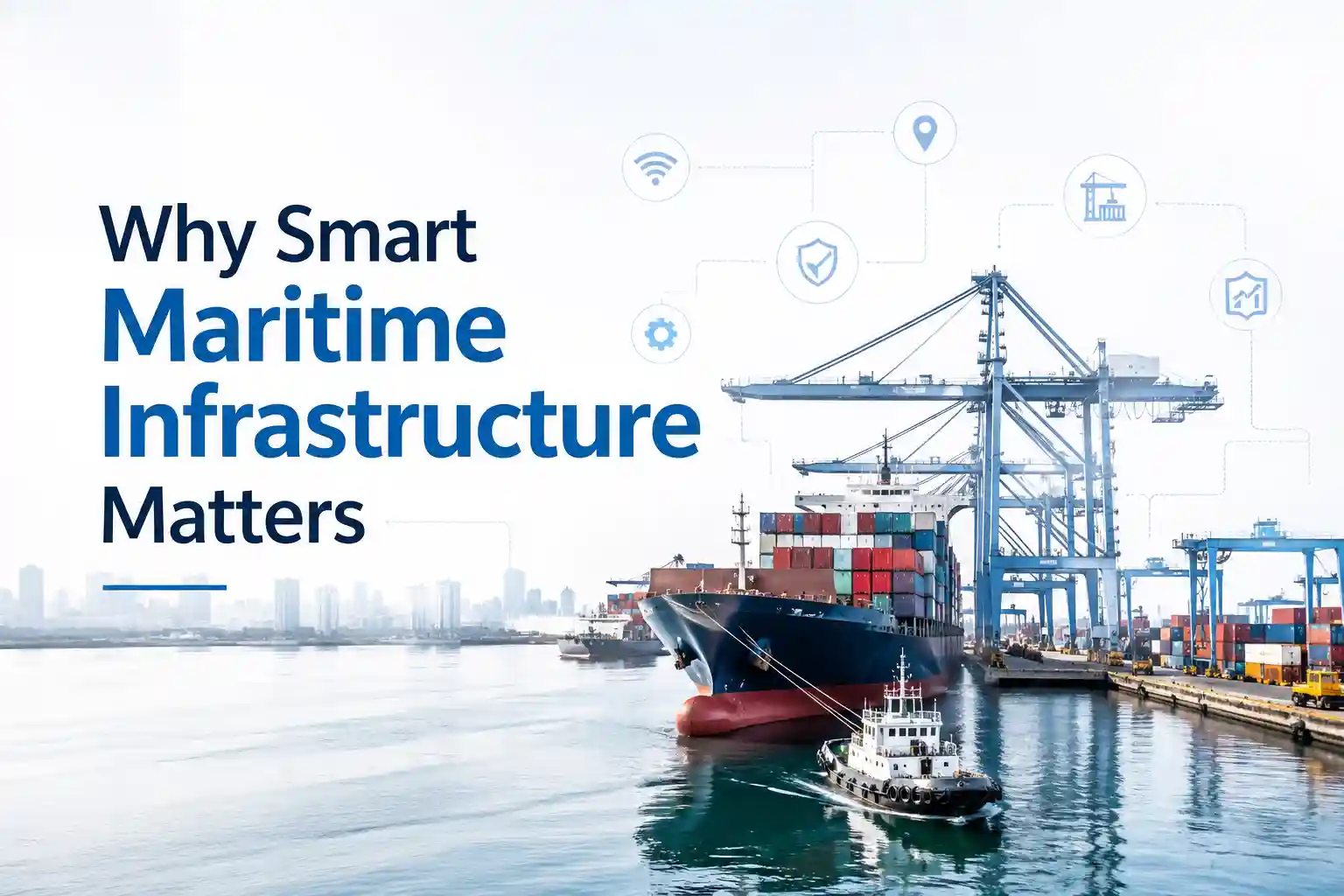

Why Smart Maritime Infrastructure Matters: Smart Port Infrastructure After the Demo
The berth allocation system pushed the 14,000 TEU vessel into Slot 7 at 03:47. Terminal operating systems confirmed crane availability. Truck appointment slots released. Everything on the integrated dashboard glowed green, synchronized, optimized.
Then the squall line hit. Wind shifted thirty degrees in four minutes. Visibility dropped below half a cable. The pilot requested holding. The berth sat empty. Cranes idled, burning diesel. The dashboard, three hundred miles inland, still read “On Schedule” because the delay hadn’t propagated through the data pipeline yet.
That lag isn’t a bug. It’s the operational baseline for smart maritime infrastructure in 2026. The technology works. The integration is real. But weather doesn’t submit JSON payloads, and salt spray doesn’t respect API contracts. What separates viable deployments from expensive shelfware isn’t model sophistication. It’s whether the system was built with enough friction tolerance to survive actual port operations.
What “Smart” Looks Like When the Humidity Hits 95 Percent
Vendor demonstrations happen in climate-controlled rooms with simulated feeds. Real deployments happen on quay walls where vibration from rubber-tired gantry cranes shakes loose unsecured connectors, and salt crystallization builds on antenna radomes faster than maintenance crews can clean them.
I’ve walked through three different “smart port” implementations in the last eighteen months. The common thread isn’t the technology stack. It’s the gap between the integration diagram and the physical reality of keeping sensors alive in a marine environment. One Northern European terminal spent eighteen months getting its computer-vision crane system to work in clear conditions. Then winter arrived. Fog, low-angle glare, and precipitation reduced object detection accuracy by roughly forty percent. The system didn’t fail. It just required human oversight, exactly when the business case promised reduced labor.
Hardware specifications matter less than installation craft. A LiDAR sensor rated IP68 will still drift if the mounting bracket flexes during high-wind events, misaligning calibration by two degrees. That’s enough to misclassify a stacked container as clear airspace. The software logs a “minor anomaly.” The yard supervisor gets a false clearance alert. Nobody notices until a spreader nearly clips a top-tier box during a night shift.
Connectivity architecture compounds these issues. Private 5G networks promise low-latency control signals, but spectrum interference from vessel radar systems can create dead zones near active berths. Hybrid satellite-terrestrial failover sounds elegant until you watch a handover during heavy rain fade, where the system briefly defaults to a 3G fallback that can’t handle the telemetry load. The platform doesn’t crash. It just starts dropping non-critical packets. Those “non-critical” packets often include the environmental sensor data that triggers storm-prep protocols.
Crews adapt, but not in ways that align with vendor documentation. I’ve seen terminal operators tape over status LEDs on quay-side sensors because the constant blinking interfered with night-vision bridge operations. I’ve watched IT staff reroute fiber runs away from high-voltage crane power lines after electromagnetic interference corrupted position data. These aren’t deviations from best practice. They’re survival tactics for keeping the system functional when the installation manual meets the real world.
Testing the System Under Realistic Stress
I simulated intermittent connectivity conditions using buffered satellite uplink patterns and delayed AIS refresh intervals to observe how quickly stale port data becomes operationally misleading. The setup wasn’t meant to stress-test hardware. It was meant to watch how operators respond when the dashboard stops matching the deck.
Within six minutes of simulated uplink loss, the monitoring portal began interpolating yard crane positions based on the last received vector. The crane was actually holding position during a wind hold. The dashboard drew a smooth, automated repositioning sequence. Dispatch almost rerouted incoming trucks. I had to manually flag the data window and request a raw screenshot from the terminal’s local HMI before anyone acted on the interpolated line.
The discrepancy didn’t come from faulty sensors. It came from software assuming consistent motion when the environment was actively resisting it. Predictive yard optimization works beautifully in calm conditions. It struggles when wind, tide, and labor availability pull operations out of their projected path faster than the uplink can report the correction.
Software friction compounds during peak traffic. When multiple subsystems publish alerts to the same workspace—crane maintenance flags, truck gate delays, customs hold notifications, weather advisories, operators scroll past three dozen status indicators to find the one parameter that actually matters during a disruption. The interface doesn’t fail. It just demands more cognitive bandwidth than a single supervisor can reasonably spare during active operations.
I’ve noticed that the most effective remote setups don’t push every available metric to the dashboard. They filter aggressively. They suppress routine fluctuations. They prioritize deviations that exceed operational thresholds. The rest sits in local logs for later review. It’s a less elegant approach, but it prevents alert fatigue from masking genuine faults.
Who Actually Extracts Value, and Who Pays the Training Tax
The operators who get real value from integrated port systems aren’t reading deployment brochures. They’re the terminal managers who cross-reference crane utilization logs with tidal windows, then wash them against historical weather routing data to identify inefficiency patterns. They understand that telemetry isn’t a command center. It’s an auxiliary layer that supports decision-making when calibrated correctly.
Frontline staff rarely treat these dashboards as primary decision tools unless the alert thresholds match actual operational ranges. If an alarm triggers every time a crane motor temperature fluctuates within normal working bands, it gets silenced. Permanently. Implementation resistance rarely comes from stubborn supervisors. It comes from systems that demand more screen time than the watch schedule allows, and more diagnostic follow-up than the maintenance budget supports.
Training isn’t a one-week certification. It’s three to six months of tweaking alert bands, watching what actually fails under load, and accepting that half the diagnostic flags are false positives from sensor placement, not mechanical wear. The learning curve isn’t steep, but it’s long. You need operators who understand the difference between a genuine system anomaly and an environmental artifact. You need engineers who know how to trace a corrupted data packet back to a fatigued coaxial connector or a misconfigured NMEA multiplexer.
Infrastructure requirements scale quickly. Low-earth orbit satellite terminals require clear sky visibility and stable antenna alignment. Older VSAT systems on charter vessels prioritize voice and email traffic over telemetry packets, starving the remote dashboard during bandwidth contention. Cellular gateways work beautifully within ten nautical miles of shore, then drop entirely past headland interference. Hybrid comms architectures solve the coverage problem, but they add configuration complexity, additional failure points, and a heavier maintenance burden for onsite technical staff.
The cost-to-practicality ratio rarely breaks even on efficiency gains alone. The real return comes from reduced unplanned downtime, earlier detection of gradual sensor drift, and better asset utilization data. But those benefits only materialize when the system is integrated into existing maintenance workflows, not layered on top of them as an afterthought.
Coastal Terminals vs. Deep-Water Hubs: Different Problems, Different Solutions
Coastal operations compress the error margin. You’re within VHF range most of the day. Cellular towers bounce off headlands, and AIS updates arrive in near real-time. The telemetry system mostly sits idle, logging crane cycles, gate transactions, and energy consumption. Software behaves predictably. Hardware stays dry behind enclosed control rooms. Maintenance intervals align with scheduled port calls.
Push into major deep-water hubs handling ultra-large container vessels, and the entire monitoring paradigm shifts. Satellite latency stretches during constellation handovers. Wind and swell mask acoustic positioning references. Pitch and roll introduce measurement noise that requires aggressive filtering. Older terminal operating systems run on legacy protocols that choke when you try to push high-frequency sensor arrays through outdated multiplexers.
Automated monitoring works well when the environment behaves predictably. Manual oversight becomes the backup plan when it doesn’t. I’ve seen hybrid setups where the control room keeps a paper log of crane load shifts during heavy weather because the automated trendline smoothed out the spike caused by a sudden wind gust. The system didn’t malfunction. It just averaged the data in a way that erased the operational reality.
Commercial-grade industrial IoT hardware handles this better than consumer-grade sensors, but only marginally. Commercial terminals include better error correction, redundant power inputs, and wider operating temperature ranges. They still struggle with antenna misalignment during high-wind events, and they still suffer from firmware updates that occasionally break legacy protocol parsers. The difference is that commercial crews know how to roll back a patch while the terminal is operational. Smaller ports usually don’t.
Older infrastructure compounds these limitations. Terminals built before 2010 rarely have dedicated telemetry routing channels. You tap into existing crane monitoring lines, splice into gate alarm circuits, and hope the signal isolation holds. It usually does, until thermal expansion shifts a ground plane and introduces voltage drift. You don’t find the problem until audit data doesn’t match onsite logs. By then, you’ve been operating on skewed readings for weeks.
Why the Dashboard Sometimes Tells a Convenient Story
Port operational logic doesn’t translate cleanly into digital dashboards. A terminal isn’t a static node. It’s a dynamic system responding to tides, weather, labor availability, and human intervention. When a telemetry system reports a sudden drop in crane throughput, the algorithm looks for a fault. The supervisor knows the crane was manually throttled back because a customs inspection held up container release. The software lacks context. It reports what it measures, not what it understands.
Infrastructure limitations amplify the problem. Satellite constellations promise near-constant coverage, but antenna alignment on rolling vessel decks introduces signal dropouts that aren’t logged as outages. They register as data gaps. The remote interface fills them with interpolated lines. The terminal was actually managing a labor shortage. The dashboard draws steady throughput.
Hardware degradation is rarely catastrophic. It’s cumulative. A corroded ground plane, a fatigued coaxial connector, a fouled flow sensor, a stretched tension cable on a position transducer. Each one degrades the signal-to-noise ratio just enough that the remote interface starts averaging instead of reflecting. Operators adapt by layering redundancy, but redundancy adds weight, cost, and another set of maintenance intervals that compress during peak operations.
Communication reliability fluctuates with atmospheric conditions. Solar activity disrupts ionospheric propagation. Heavy precipitation attenuates Ku-band signals. High sea states scatter antenna lobes. The telemetry system doesn’t fail during these conditions. It just operates at reduced fidelity, reporting what it can capture while the rest sits buffered until the next uplink window.
Human workflow adaptation is the only thing that bridges the gap. Control room staff learn to read the dashboard skeptically. They verify critical alerts with physical checks. They ignore routine fluctuations that fall within normal operational bands. They log discrepancies manually when the software smooths out reality. It’s inefficient on paper. It’s necessary in practice.
Recent maritime engineering research from coastal labs aligns with these observations. Deployment studies consistently note that automated anomaly detection works best when calibrated to specific terminal layouts, crane configurations, and operational profiles. Generic thresholds generate false positives at an unsustainable rate. The harbor environment introduces noise that lab validation rarely captures. NOAA buoy datasets and tidal modeling studies confirm how environmental variables distort sensor readings when telemetry gates don’t filter for wave-induced motion and atmospheric interference.
Documented Friction Points Worth Planning For
The friction accumulates in predictable places, but only if you know where to look.
Salt creep along unsealed DIN rail connections causes phantom voltage readings that trigger low-power warnings. Cable runs routed near high-voltage crane lines soften over eighteen months, requiring replacement during scheduled maintenance windows. Dashboard clutter becomes a real issue when every subsystem publishes to the same remote interface. You’re scrolling past battery backup status, gate cycle times, and emissions monitoring to find the one parameter that actually matters during a disruption.
Software updates push through during low-traffic periods, but firmware patches occasionally break legacy protocol parsers, forcing the IT contractor to roll back while the terminal is operational. Sensor degradation on ultrasonic position markers shows up as a gradual measurement drift that only gets caught during physical audits. The learning curve isn’t steep, but it’s long. Staff spend more time troubleshooting false alerts than they do responding to actual faults.
Corrosion doesn’t wait for warranty periods to expire. It exploits every unsealed interface, every poorly routed cable tie, every mounting bracket that vibrates against painted steel. Maintenance burden scales non-linearly once you exceed the manufacturer’s recommended operating envelope. Inconsistent tracking emerges when satellite handovers collide with heavy weather masking antenna patterns. Weather interference isn’t an exception. It’s the baseline.
Unreliable updates compound dashboard frustration. When the system refreshes every 30 seconds during cellular coverage, then drops to 90-second intervals during satellite handover, the remote interface starts displaying stale yard data that conflicts with the local HMI. Operators adapt by trusting local instruments over remote portals. It’s a rational compromise, but it undermines the original purpose of the deployment.
Installation delays rarely stem from missing components. They come from terminal geometry constraints, existing wiring congestion, and the reality that retrofitting a monitoring system onto a working port means interrupting normal operations for days while technicians route cables, test signal isolation, and calibrate sensor baselines. You can’t just plug it in and walk away. You have to integrate it into an ecosystem that’s already running at capacity.
The Practical Compromise
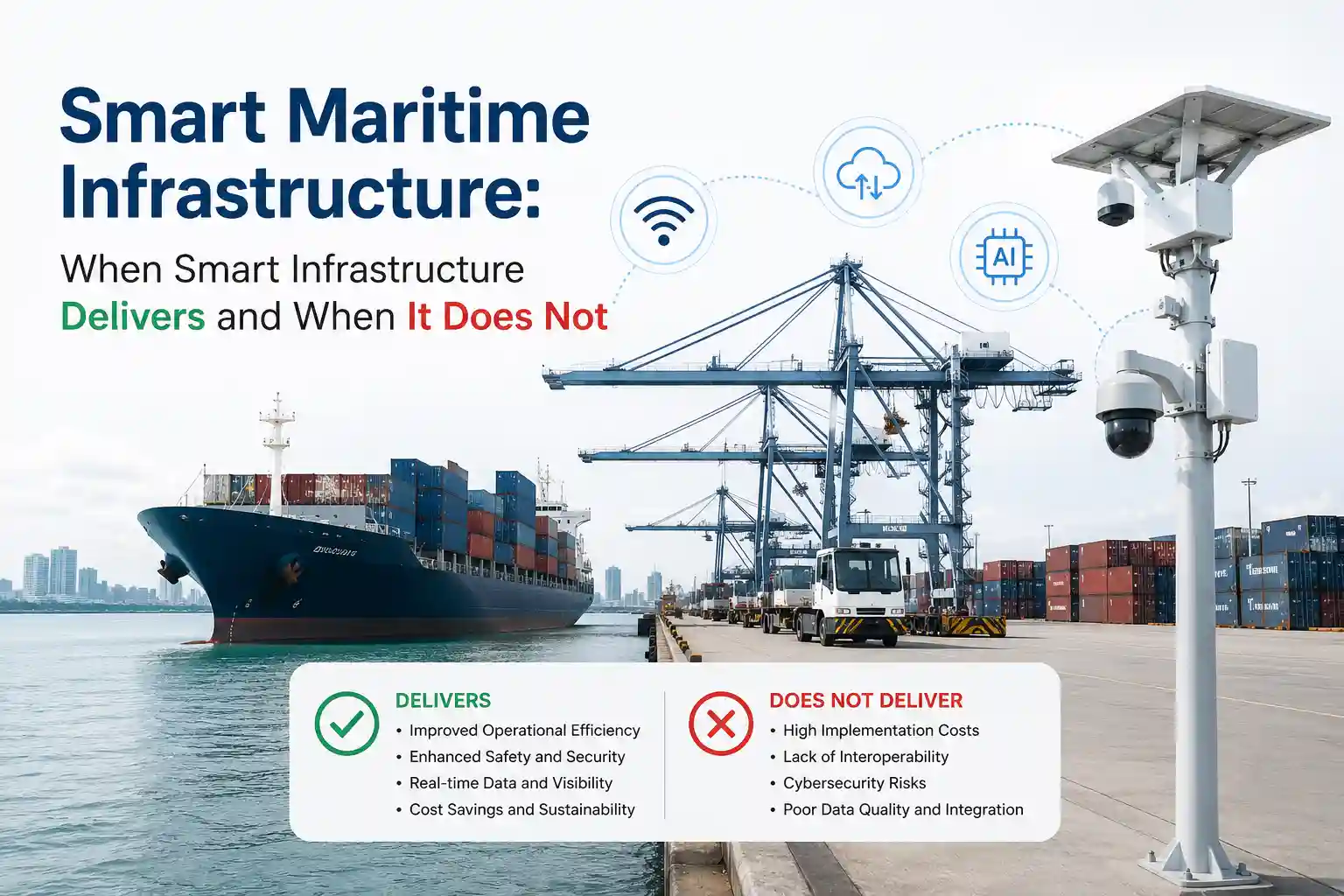
Integrated port telemetry works when it’s treated as an auxiliary layer, not a command center. Operators who survive deployment friction don’t chase perfect data streams. They build tolerance for latency, cross-reference dashboard flags with physical checks, and accept that some parameters will drift until maintenance can catch them. The systems are useful. They’re just not autonomous.
You still need someone in the control room who knows the difference between a sensor glitch and a real problem. Someone willing to wipe salt off a terminal screen, trace a corrupted data packet back to a loose ground lug, and understand that harbor conditions rarely match the calibration spreadsheet. You need terminal managers who recognize that remote monitoring reduces guesswork, but doesn’t eliminate the need for experienced judgment.
The technology doesn’t replace port expertise. It extends it. It gives you more data to work with, but it also gives you more ways to misinterpret what you’re seeing if you don’t understand the environment it’s measuring. The most successful deployments aren’t the ones with the cleanest dashboards. They’re the ones where operators know exactly what the system can’t see, and they compensate accordingly.
IMO guidelines on maritime digitalization encourage data standardization, but they don’t resolve the commercial tensions underneath. A terminal operator wants real-time cargo manifests to optimize yard planning. A shipping line wants to withhold that data until the vessel is alongside to preserve scheduling flexibility. Customs agencies want advanced documentation but operate on different legal timelines than commercial operators. The smart infrastructure has to accommodate all these constraints simultaneously, or it becomes another siloed system that requires manual reconciliation.
In 2026, that’s the baseline. Not autonomous ports run by AI. Not seamless integration across all stakeholders. Just better tools for the people who already keep global trade moving, working in an environment that remains stubbornly, beautifully resistant to perfect optimization.
The harbor doesn’t care about your API. The smart ports that thrive are the ones that remember that.