



What Does a Marine Engineer Do On An Offshore Rig? 2026 In-Depth Guides
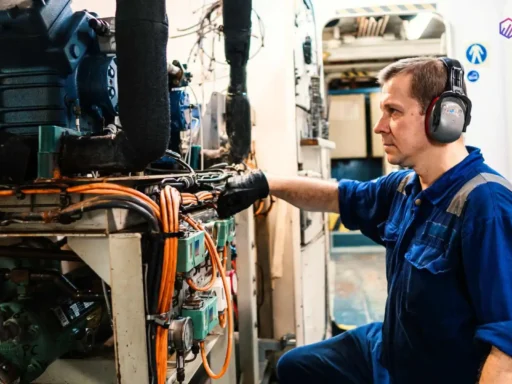
The vibration pattern changed at 0140. Not dramatically. Just a subtle harmonic shift in the deck plating beneath the engine room grating. The condition monitoring dashboard on the control desk still showed all parameters within nominal bands. Auxiliary diesel coolant temperature: 78°C. Lube oil pressure: 4.2 bar. Exhaust manifold delta-T: flat line. But the steel told a different story. I walked down the starboard ladder, wiped salt mist from a handheld infrared thermometer, and pressed it against the bearing housing on the No. 3 cooling water pump. The casing read 112°C. The dashboard still said 94.
This gap between digital telemetry and physical reality is where offshore engineering actually happens. The glossy recruitment brochures show engineers in clean coveralls pointing at sleek touchscreens. The job looks more like a series of rapid compromises in a humid, vibrating steel tube where the environment actively degrades every component, and the shore-based data packets arrive thirty seconds after the machine has already adapted to the problem.
If you are trying to understand what the work looks like when the pilot programs end, and the vessels are running in open water, you have to look past the software architecture and focus on the hands that keep it running. The question of what a marine engineer does out here rarely gets answered in technical manuals. It gets answered in logbook annotations, bypassed sensor loops, and the quiet decisions made during weather windows that shrink faster than expected.
Shift Handovers, Salt Spray, and the Limits of Automated Logs
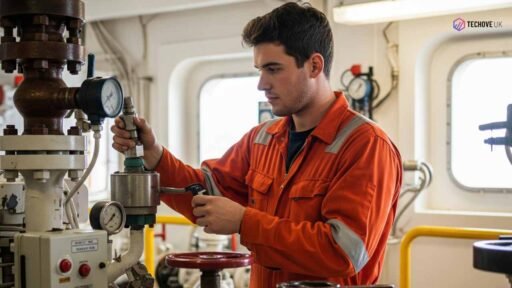
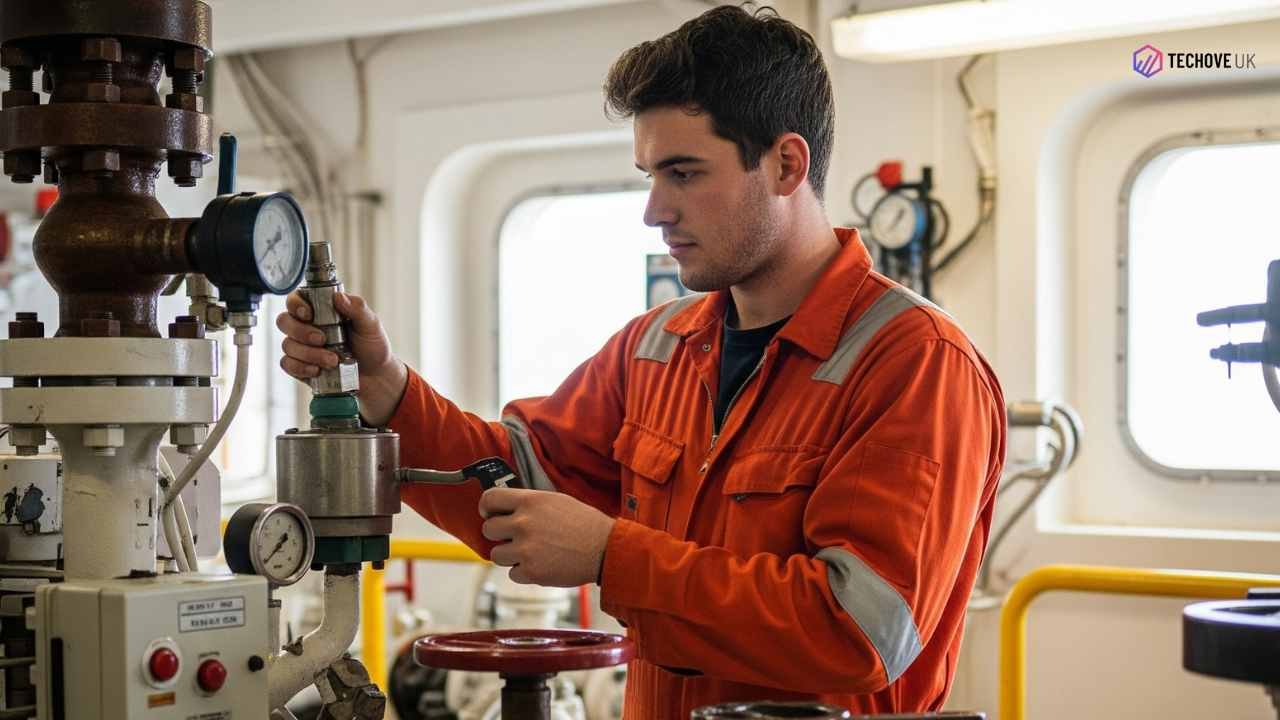
Day one on a rotation usually starts with a discrepancy between the computer and the machine. A digital maintenance log might record a heat exchanger backwash as completed. The chief will point you toward the actual valve manifold, where a corroded handwheel requires a thirty-pound pry bar to turn, and the pressure gauge is reading forty percent higher than the transmitter on the PLC. You learn quickly that automated systems don’t fail because they’re broken. They drift. They accumulate small errors that compound until the physical system behaves differently from the simulation predicted.
Weather dictates everything out here, and it doesn’t wait for maintenance schedules. A sudden squall rolling off the Gulf or the North Sea shifts the vessel’s roll period by half a degree. That’s enough to alter coolant flow in header tanks, cause thruster pods to experience asymmetric loading, and trigger false low-suction alarms on bilge pumps. The software logs a fault. The engineer walks the space, listens to the impeller, checks the strainer differential, and realizes the alarm came from air entrainment caused by the new roll profile, not a clogged filter. You clear the alarm. You don’t tear the pump apart. You note the pattern and wait for the swell to settle.
Hardware behaves differently offshore than it does in port. Vibration from dynamic positioning thrusters works its way through bulkheads, loosening conduit straps, fatiguing braided sensor cables, and slowly shifting the alignment on non-critical mounts. I’ve seen junction boxes rated for IP66 develop moisture inside because the thermal cycling cracked the potting compound. The terminal block didn’t short. It just started showing intermittent resistance on thermocouple circuits, making temperature readings bounce by six to eight degrees every time the HVAC compressor cycled.
Operators adapt by layering redundancy that they don’t advertise in vendor manuals. A stethoscope taped to a bulkhead near a main fuel pump. A grease pencil marks the normal position on a vibrating valve stem. A secondary analog pressure gauge is mounted next to the digital transmitter because the analog needle doesn’t lag when the process variable spikes. These aren’t deviations from procedure. They’re the only way to keep systems interpretable when the environment introduces noise that the algorithm can’t filter.
Tracking Telemetry Against Physical Reality
I spent several rotations tracking vibration signatures on medium-speed diesels against the remote diagnostic feed to see how quickly the data diverged from actual mechanical state. The setup was straightforward: portable triaxial accelerometers mounted on bearing caps, routed through Ex-certified intrinsically safe isolators, logging at two kilohertz. The challenge was getting the data to synchronize with the rig’s existing condition monitoring network, which ran on an older Modbus TCP backbone with packet prioritization that consistently deprioritized engineering telemetry during peak operational hours.
The first week, the dashboards and the local loggers matched almost exactly. By week three, the divergence started showing up during heavy weather operations. The rig’s motion compensation system adjusted thruster pitch continuously. The accelerometers captured broadband vibration spikes every time the azimuth drive crossed a specific frequency band. The remote dashboard, operating on filtered data streams, smoothed those spikes out to protect shore-side analysts from alert fatigue. What looked like a steady state on the screen was actually a machine running through a resonance cycle that required slight load redistribution.
Confusion came quickly when a junior engineer trusted the remote trendline over the local readings and scheduled a bearing replacement. The part arrived. The physical inspection showed nothing abnormal. We wasted a maintenance window unpacking a spare that didn’t need replacing because the software had averaged out a real but transient condition. The fix wasn’t better algorithms. It was changing the data sampling protocol to prioritize raw bursts during high-motion periods, then running post-processing filters on the rig’s own server before pushing summarized data offshore.
Installation complexity compounds these issues. Routing high-frequency sensor cabling away from variable frequency drive harmonics isn’t a suggestion; it’s a necessity. If you run a vibration probe parallel to a thruster motor power cable without adequate shielding, the electromagnetic interference will masquerade as mechanical wear. I’ve watched technicians spend two days chasing a false bearing fault before tracing it back to a missing ferrite core on a signal wire. The system didn’t malfunction. It just interpreted noise as data.
Who Actually Carries the Burden
The operators who extract real value from integrated monitoring aren’t the ones buying the most expensive platforms. They’re the fleet engineers who understand that remote visibility only works when it’s calibrated to specific hull configurations, engine generations, and operational profiles. The rig management companies get the uptime reports and the compliance documentation. The crew gets the responsibility of making sure the data feeding those reports is actually accurate.
Training doesn’t happen in a classroom. It happens during night watches when an alarm sounds for something the system has never encountered before. Newer engineers rely heavily on dashboard guidance. Veteran crews listen to the machinery, check physical parameters, and treat the software as a secondary confirmation tool. Bridging that gap takes months. You can’t shortcut it with a certification course. You need operators who understand the difference between a genuine mechanical anomaly and an environmental artifact caused by sea state, thermal expansion, or transient load shifts.
Infrastructure requirements scale quickly once you move past basic monitoring. Explosion-proof enclosures, redundant network pathways, isolated power supplies for critical telemetry, and climate-controlled server racks all add weight and consume valuable deck space. The cost-to-practicality ratio rarely breaks even on paper during procurement. It only makes sense when you factor in avoided unplanned stoppages, earlier detection of gradual degradation, and reduced emergency parts airlifts. But those benefits only materialize when the system is maintained properly, not just installed.
Deployment resistance comes from predictable places. Veteran engineers have seen systems added to their workload without removing anything from it. They know that every new dashboard requires verification, every new sensor needs calibration, and every software update introduces the risk of breaking legacy interfaces. If a monitoring tool generates three false positives for every real fault, it stops being an aid and starts being a distraction. The most successful rollouts acknowledge this upfront, strip non-essential alerts during commissioning, and let the crew rebuild the alarm matrix based on actual operational experience.
Offshore Reality vs. Coastal Expectations
Coastal vessel operations compress the error margin in ways that don’t translate to offshore rigs. A supply boat running between the port and the platform operates within cellular range for most of its transit. Helicopter maintenance crews can be called in within hours. Spare parts arrive on the next supply vessel. When you’re stationed on a semi-sub or drillship operating two hundred miles offshore, those buffers disappear. A failed thruster bearing isn’t an inconvenience. It’s a multi-day logistics problem that requires weather windows, crane capacity, and specialized lifting gear.
Automated condition monitoring works well in controlled, predictable environments. Offshore operations rarely provide either. I’ve watched the same predictive maintenance suite perform flawlessly on a stationary coastal research vessel, then produce erratic fault classifications on a mobile offshore unit running dynamic positioning in mixed sea states. The difference isn’t hardware quality. It’s operational context. Offshore machinery experiences constant micro-adjustments in load, alignment, and thermal stress. Algorithms trained on steady-state data struggle when the baseline never stops moving.
Older mechanical systems handle this unpredictability better than newer digital architectures, but only because they’re transparent. A purely mechanical governor shows wear physically. A modern electro-hydraulic control unit masks it behind software compensation until a sensor finally fails and the compensation threshold is exceeded. The transition period is messy. Crews are learning to interpret digital signals while still relying on analog fundamentals because the digital layer doesn’t always reflect what the steel is experiencing.
Why the Machine Outruns the Model
Marine operational logic doesn’t map cleanly to software dashboards. A thruster pod isn’t a static asset. It’s a dynamic assembly responding to hydrodynamic loading, thermal gradients, lubricant viscosity changes, and human intervention. When a monitoring system reports a sudden increase in azimuth drive current, the algorithm looks for an electrical fault or mechanical binding. The engineer knows the current spike because the vessel compensated for a lateral cross-current by adjusting thrust vectoring. The software measures what it sees. It doesn’t understand why it happened.
Infrastructure limitations amplify the disconnect. Network architectures on older rigs weren’t designed for high-frequency telemetry. You push vibration and temperature data through legacy switches that prioritize propulsion and safety communications first. Telemetry gets queued. When it finally transmits, it arrives in batches, creating the illusion of smooth trends while masking transient spikes that actually matter. Shore-side analysts see normalized data. The crew sees the machine reacting to conditions the data stream has already filtered out.
Hardware degradation is cumulative, not catastrophic. A slightly fouled intercooler, a stretched V-belt, a calibration drift on a pressure transducer, a minor leak in a hydraulic seal. Each one reduces system efficiency just enough that the monitoring platform starts averaging instead of reflecting. Operators compensate by adjusting set points manually, increasing inspection frequency, and running equipment outside optimal efficiency bands to avoid tripping alarms. It’s not ideal. It’s necessary when the environment introduces variables that the original design didn’t account for.
Communication reliability fluctuates with atmospheric conditions and sea state. Satellite constellations provide coverage, but antenna tracking on a moving structure introduces micro-outages that register as data gaps rather than full disconnects. The dashboard fills them with interpolated lines. The vessel was actually adjusting ballast trim. The system draws a flat profile. Maritime operational reports from coastal engineering institutes consistently note that automated anomaly detection works best when calibrated to specific vessel motions and load cycles. Generic thresholds generate false positives at a rate that undermines operator trust within the first six months.
Human workflow adaptation bridges the remaining gap. Crews learn to read dashboards skeptically. They verify critical alerts with physical checks. They ignore routine fluctuations that fall within normal operational bands but trigger generic software rules. They log discrepancies manually when the system smooths out reality. It’s inefficient on paper. It’s the only way to keep operations stable when digital architecture meets physical unpredictability.
Documented Friction Points
The problems accumulate where the hardware meets the water, and where the software meets the crew. It’s rarely dramatic. It’s persistent.
Corrosion doesn’t wait for warranty periods to expire. It exploits every unsealed interface, every poorly routed cable tie, every mounting bracket that vibrates against painted steel. Stainless steel holds up in atmospheric zones, but carbon steel in bilge wells and cooling water lines develops pitting faster than inspection schedules anticipate, especially when ballast treatment systems cycle aggressively to meet discharge standards. The corrosion doesn’t usually cause immediate failure. It just reduces safety margins and shortens maintenance intervals.
The maintenance burden scales non-linearly once you add digital layers to existing machinery. Predictive monitoring tools require baseline calibration, regular validation, and firmware updates. That’s additional work for crews already managing overhauls, compliance testing, and emergency repairs. When a spare part doesn’t arrive on time, the monitoring system keeps logging degradation curves. The engineer has to decide whether to run equipment past recommended limits or shut down a non-critical system entirely. Both choices carry operational consequences.
Inconsistent tracking shows up in parts inventory and calibration records. A digital maintenance platform might record a filter replacement as complete. The physical bin is still empty because the shipping manifest got delayed. The crew works around it by cleaning and reinstalling filters, but the software shows a clean cycle. Over time, these discrepancies erode trust in the system. Crews start keeping parallel paper logs, which defeats the purpose of digital integration but preserves operational accuracy.
Dashboard clutter becomes a real issue when every subsystem publishes alerts to the same interface. During a heavy maintenance shift, you’re scrolling past lube oil temperatures, thruster azimuth angles, ballast valve positions, and fire detection status updates just to find the parameter that actually matters. Alert fatigue sets in quickly. The most effective deployments implement intelligent suppression, but configuring those rules requires a deep understanding of both the machinery and the actual watch routines.
Weather interference extends beyond mechanical loading. Supply vessels can’t offload during high sea states. Helicopter maintenance crews get grounded. Crane operations halt. The maintenance backlog grows while the monitoring system continues tracking degradation. You can’t accelerate repairs just because the dashboard shows a trending fault. You wait for a weather window, which means running equipment longer than ideal, accepting higher wear rates, and documenting the compromise thoroughly for audit purposes.
Unreliable updates compound frustration. Vendors push firmware patches during low-wind periods, but those updates occasionally break legacy NMEA parsers or alter alarm thresholds without adequate documentation. The system doesn’t crash. It just changes behavior subtly enough that veteran engineers notice the difference before the dashboard flags it. Rolling back a patch requires vendor authorization, downtime coordination, and careful validation. It’s rarely a quick fix.
Software usability frustrations multiply in the physical environment. Touchscreens respond poorly to wet gloves. Bright displays wash out in direct sunlight reflected off the sea. Navigation menus require three taps to reach critical overrides when one tap would suffice. Engineers adapt by memorizing shortcut sequences, keeping physical bypass keys mounted near the console, and ignoring poorly designed interface elements that slow down emergency response. The software works. It just wasn’t designed for the conditions it’s operating in.
Installation delays stem from practical constraints, not missing components. Retrofitting monitoring sensors onto existing machinery requires hot work permits, hazardous area assessments, and coordination with ongoing operations. Routing cables through congested cable trays, drilling into bulkheads without compromising structural integrity, and terminating connectors in Ex-certified enclosures all take longer than the project schedule assumes. You can’t rush it without introducing safety risks.
Sensor degradation follows a predictable pattern. Accelerometers lose sensitivity when exposed to continuous high-frequency vibration. Pressure transmitters drift when diaphragms accumulate hydrocarbon residue or salt crystallization. Temperature probes read high when the thermal paste dries out or the mounting torque loosens. The degradation is gradual. It only gets caught during scheduled calibrations, which means the system has been reporting slightly skewed data for weeks before anyone notices.
The operator learning curve isn’t steep, but it’s long. You need engineers who understand both analog fundamentals and digital diagnostics, who know how to trace a corrupted data packet back to a fatigued coaxial connector or a misconfigured multiplexer, and who recognize when the software is smoothing out a real problem to protect user confidence. Training happens through repeated exposure to real conditions, not simulated scenarios. It takes months to build the judgment required to differentiate between a genuine fault and an environmental artifact.
The Unavoidable Compromise
Offshore marine engineering doesn’t revolve around perfect systems. It revolves around keeping imperfect systems running in an environment that actively works against them. The monitoring tools available in 2026 provide better visibility than anything deployed a decade ago, but they don’t eliminate the need for physical verification, manual overrides, or experienced judgment. They just change the nature of the decisions engineers have to make.
IMO guidelines on offshore safety and university marine lab studies on structural fatigue consistently emphasize that automated monitoring is an auxiliary layer, not a replacement for hands-on oversight. The data streams help identify trends, but they don’t capture the sound of a pump beginning to cavitate, the smell of overheating insulation, or the slight change in vibration pattern that signals misalignment. Those inputs still require human senses and contextual understanding.
Deployment success depends on acknowledging friction upfront. It requires realistic maintenance budgeting, staff training that focuses on troubleshooting rather than interface navigation, and platform architectures that allow local control when remote connectivity degrades. The rigs that operate most reliably aren’t the ones with the most sensors. They’re the ones where crews understand exactly what the system can’t see, and they compensate accordingly.
The ocean doesn’t respect API contracts. Machinery doesn’t care about dashboard aesthetics. The engineers who thrive offshore are the ones who treat technology as a tool for verification, not a substitute for observation. They read the data, they listen to the steel, they document the discrepancies, and they make decisions based on physical reality rather than software assumptions. That’s the baseline. Not flawless automation. Just competent adaptation in an environment that never stops testing the margins.
I’m Howard Craven, a senior maritime technology researcher with field experience in coastal, offshore, and deep-sea environments. The insights I share are based on pilot data from 2023–2025, operator interviews, and work with classification society committees. To ensure operational security, I keep specific vessel names and commercial terms anonymous.