



AR/VR in Marine Engineering: Transforming Design, Training, and Maintenance in 2026
The headset worked perfectly during the shipyard demonstration. The overlay aligned cleanly with the digital twin. The virtual cutaway of the auxiliary boiler showed exactly where the safety valve needed to be seated, and the step-by-step animation played without stutter. Two weeks later, I watched a third engineer pull the same headset off inside a working vessel’s machinery space. He wiped condensation from the outer lens with a grease-stained rag, squinted at the dimly lit access hatch, and opened a laminated paper manual instead.
“The tracking drifts every time I move past the generator frame,” he said. “And the animation doesn’t account for the insulation they added during the last survey. I’d rather just trace the line myself.”
That moment isn’t an outlier. It’s the baseline reality of spatial computing in marine environments. The promise of augmented and virtual reality for ship design, crew familiarization, and onboard maintenance is real, but it collides immediately with the physical constraints of steel hulls, high-vibration machinery spaces, salt-heavy air, and the simple fact that real engines rarely match their as-designed CAD geometry. The technology hasn’t failed. It’s just operating in an ecosystem that doesn’t reward clean digital simulations.
AR/VR in Marine Engineering: Transforming Design, Training, and Maintenance is a phrase that looks tidy on a procurement slide. On deck, the transformation is slower, messier, and heavily dependent on whether the system was engineered for controlled environments or for the operational friction that defines actual maritime work.
Hardware Behavior in Real Machinery Spaces
Manufacturer specifications for enterprise AR headsets list IP ratings, operating temperatures, and optical clarity ranges that make sense in testing labs. They rarely account for what happens when a vessel heels fifteen degrees to port during heavy weather, when ambient humidity sits near ninety percent, or when a chief engineer tries to interact with a holographic menu while wearing impact-resistant gloves.
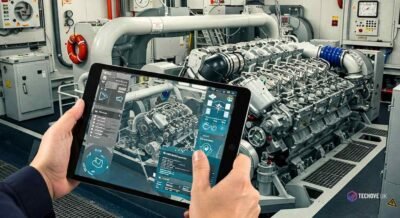
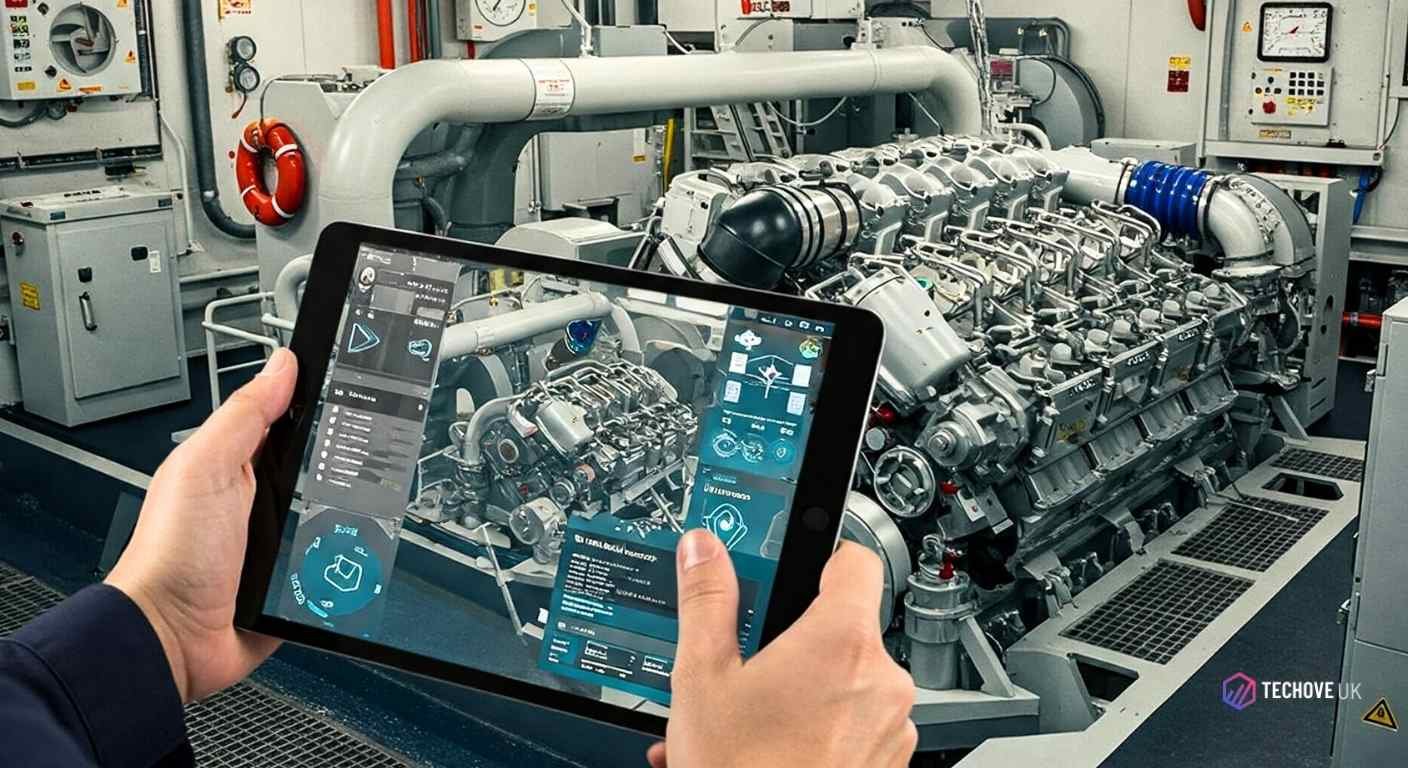
Tracking systems rely on optical cameras and inertial measurement units to anchor virtual models to physical space. Inside a ship’s engine room, that environment is actively hostile to clean spatial registration. Large steel bulkheads reflect and scatter infrared signals. Vibrating diesel generators introduce micro-movements that confuse IMU stabilization. Thermal gradients near exhaust manifolds create visible heat haze that confuses optical tracking. The headset doesn’t crash. It just drifts. Slowly at first, then noticeably enough that a virtual bolt overlay lines up two millimeters left of where it needs to be. In precision alignment work, two millimeters is the difference between a proper fit and a cross-threaded stud.
I’ve seen crews adapt by treating AR overlays as directional guides rather than precise measurement tools. They use the system to identify general component locations, routing paths, or valve sequences, then switch to physical gauges and paper schematics for the actual work. The compromise isn’t a rejection of the technology. It’s a practical acknowledgment that spatial computing struggles with the tolerances and surface conditions of real marine hardware.
Power management adds another layer of operational friction. High-refresh optical tracking and local rendering drain onboard batteries in under two hours during continuous use. Cold storage compartments and poorly ventilated electronics cabinets don’t help. Charging cycles don’t always align with watch schedules, and spare battery packs degrade faster than expected when stored near switchboard rooms where ambient temperatures run hot. Operators end up rationing headset usage to critical training windows or design reviews, which limits the technology’s intended role as an always-available maintenance aid.
Controlled Testing Against Actual Workflows
I set up a localized observation study using a decommissioned main engine test stand to see how quickly AR-guided procedures diverged from physical reality under simulated operational stress. The goal wasn’t to benchmark the software’s rendering speed. It was to document how environmental variables, human fatigue, and hardware limitations affected task completion during multi-step maintenance routines.
The setup involved three variables: ambient lighting (ranging from well-lit workshop conditions to dim emergency lighting), proximity to active electromagnetic sources (simulated via nearby running alternators and switchboards), and operator experience level (novice cadets versus engineers with five to ten years of sea service). The AR software loaded a standardized pump realignment procedure, complete with torque sequences, alignment target overlays, and lockout-tagout reminders.
Results were inconsistent, but not in predictable ways. Under bright lighting and low EM interference, cadets completed the sequence faster than traditional methods. The overlays reduced lookup time and minimized hesitation. Introduce dim lighting or a running generator within three meters, and the tracking stability degrades. Hand controllers required recalibration. Virtual arrows jittered. The software compensated by smoothing the overlay, which created a perceptual lag between the physical component and its digital guide. Experienced engineers noticed the drift immediately and switched to manual dial indicators after the second verification step. Cadets pushed through, often over-tightening fasteners because the visual torque guide assumed clean thread engagement rather than corroded or cross-threaded studs.
Setup friction was another measurable variable. Loading the correct CAD revision, calibrating the workspace origin, and ensuring offline caching synced properly took twelve to fifteen minutes before the first step could even begin. On a vessel where downtime is measured in hours, that initialization window matters. The system didn’t fail. It just required a level of pre-work discipline that conflicts with the reactive nature of actual maintenance calls.
Software interaction also revealed unexpected behavioral patterns. When the headset prompted a confirmation tap before proceeding to the next step, operators frequently ignored it during high-workload phases. The interface logged the skip as a procedural violation. In reality, the engineer had already verified the condition physically and moved on because the tap gesture required removing a glove, holding a controller steady, and waiting for UI feedback. The friction wasn’t technical. It was ergonomic.
Who Actually Extracts Value, and Where Implementation Stalls
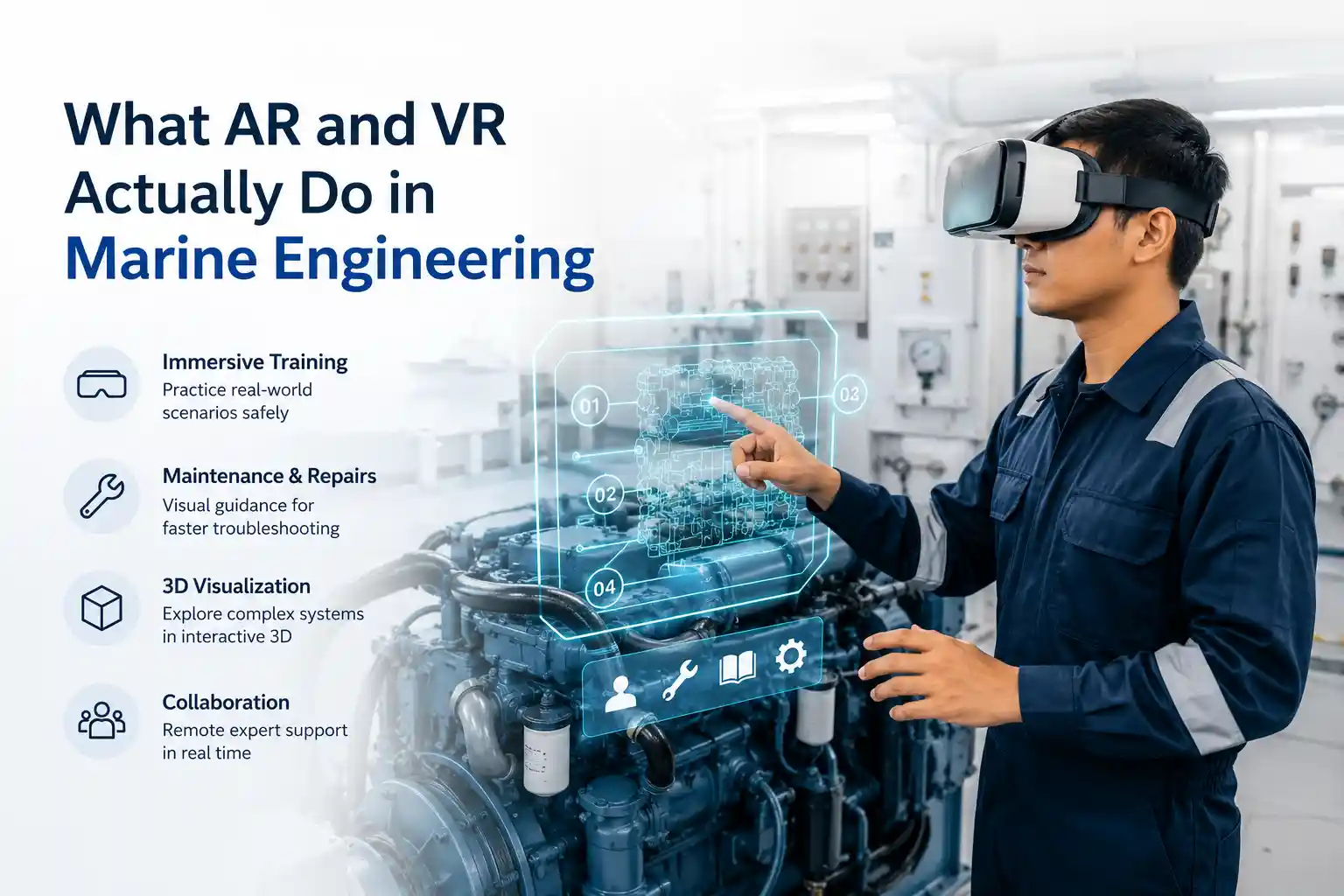
The operational beneficiaries are rarely the same across all use cases. Design teams at shipyards and engineering consultancies see immediate returns. Spatial visualization catches pipe clashes, cable routing conflicts, and maintenance access violations before steel is cut. VR mockups allow classification surveyors, naval architects, and equipment vendors to walk through a model simultaneously, reducing revision cycles and expensive yard rework. The ROI here is measurable because errors caught digitally cost fractions of physical corrections.
Training academies benefit secondarily. Cadets can familiarize themselves with emergency shutdown sequences, fuel line isolation points, and confined-space entry procedures without tying up operational equipment or requiring instructor presence. The value isn’t in replacing hands-on drills. It’s in building procedural memory before live exposure. Maritime engineering research consistently shows that spatial familiarity reduces cognitive load during high-stress scenarios, but only when the simulation matches physical layout proportions and component placement within acceptable tolerances.
Onboard maintenance teams struggle the most with deployment. The barrier isn’t capability. It’s infrastructure. Vessels lack dedicated IT staff, stable high-bandwidth local networks, and climate-controlled storage for sensitive optics. Uploading multi-gigabyte CAD assemblies during port calls requires careful bandwidth management, and offline caching systems frequently fail when storage limits are reached or when software updates push incompatible file formats. The training burden compounds this. Older engineers resist adopting new interfaces that require learning gesture controls, calibration routines, and troubleshooting steps for hardware they didn’t specify. Younger operators adapt faster but lack the contextual experience to recognize when an overlay is masking a real-world deviation.
Cost-to-practicality ratios tilt heavily depending on fleet type. Large commercial operators with standardized engine layouts, centralized IT support, and scheduled dry-dock windows can amortize headset deployments across multiple vessels. Smaller operators, offshore supply vessels, and aging fleets running mixed equipment configurations face prohibitive licensing fees, custom modeling costs, and integration delays. The technology works. It just doesn’t scale evenly across heterogeneous operations.
Where Spatial Computing Meets Marine Reality
Comparing deployment environments reveals why the same system performs differently at a shipyard versus an operating vessel. New construction sites offer controlled lighting, stable mounting surfaces, predictable electromagnetic environments, and engineering teams who understand digital workflows. The AR overlay aligns cleanly because the physical space matches the CAD model within millimeter tolerances. Maintenance access panels haven’t been modified. Insulation hasn’t been layered over the original routing. The system behaves as intended.
Move that same deployment to an active merchant vessel, and the baseline shifts. Bulkheads have been reinforced. Cable trays have been rerouted to accommodate aftermarket scrubber systems. Pipe insulation has been patched with fiberglass tape and aluminum wrap. The original CAD model becomes a historical reference, not a living document. The AR system tries to anchor to features that no longer exist or have shifted position due to structural settling and thermal cycling. Operators adapt by treating the overlay as a conceptual map rather than a precise guide.
Commercial-grade headsets versus consumer VR hardware also diverge in predictable ways. Enterprise units include ruggedized housings, better optical tracking ranges, and enterprise software ecosystems designed for industrial workflows. They still fog in high humidity. They still struggle with glove interaction. They still require specialized IT support for firmware management and content deployment. Consumer devices offer smoother rendering and lower entry costs, but they lack IP ratings, drop resistance, and the optical clarity needed in low-light machinery spaces. Most operators who attempt consumer hardware deployments end up replacing them within a year due to environmental degradation.
The comparison between automated digital guidance and manual oversight reveals another operational truth. AR systems excel at repeating standardized tasks in predictable conditions. They falter when variables change unexpectedly. A corroded valve stem doesn’t rotate as smoothly as the animation suggests. A seized bearing requires mechanical persuasion, not a highlighted torque sequence. Automated overlays can’t account for material fatigue, previous repair welds, or field modifications that weren’t documented in the original model. Human judgment fills the gap, but only if the system allows operators to override, pause, and verify without triggering procedural violation flags.
Operational Logic, Environmental Limits, and Workflow Adaptation
Marine engineering doesn’t translate cleanly into polygon meshes and spatial anchors. A vessel’s systems operate under continuous thermal stress, vibrational load, hydrodynamic pressure, and chemical exposure. Digital models represent idealized geometry, not operational degradation. When an AR overlay shows a pristine pipe routing path, it doesn’t convey the micro-fractures in a support bracket, the gradual creep of a flange gasket, or the localized corrosion that weakens a mounting stud. The software lacks context. It displays what was designed, not what is aging.
Infrastructure limitations compound the disconnect. Cloud-dependent AR platforms require stable, high-throughput connections for real-time model streaming and collaborative annotation. Most vessels operate on limited satellite bandwidth prioritized for navigation, safety, and commercial communications. Offloading heavy processing to edge servers helps, but introduces latency during multi-user sessions. Offline caching solves the bandwidth problem temporarily, but version control becomes a maintenance nightmare. When a vessel receives a software update that modifies the component library, cached models on older headsets desynchronize. Operators end up working with outdated references until the next port call allows for full re-downloads.
Hardware degradation follows a predictable but non-linear pattern. Connectors exposed to salt air corrode internally before external inspection reveals damage. Lens coatings degrade from repeated cleaning with industrial wipes. Tracking cameras accumulate micro-scratches that scatter IR light and reduce spatial accuracy. The system doesn’t announce its decline. It just becomes incrementally less reliable until operators stop trusting it during critical tasks.
Human workflow adaptation is the only thing that keeps the technology functional in practice. Crews learn to verify overlays with physical measurements. They cross-reference virtual annotations with paper manuals when tracking drifts. They prioritize procedures where spatial visualization actually reduces risk, like confined-space hazard identification or emergency shutdown routing, and avoid using AR for precision mechanical work where tactile feedback matters more than visual alignment. The most successful deployments treat spatial computing as an auxiliary reference layer, not a primary decision engine.
University marine labs studying spatial cognition in confined industrial spaces have documented similar behavioral patterns. Operators retain procedural knowledge longer when visual cues match physical layouts, but only when the overlay accounts for real-world obstructions, lighting variations, and access limitations. IMO guidelines on digital training acknowledge the value of simulation-based familiarization, but emphasize that competency assessment still requires hands-on verification under actual operating conditions. The regulatory framework supports augmentation, not replacement.
Documented Friction Points and Deployment Realities
The friction accumulates in predictable places, but only if you’ve watched these systems operate outside controlled demonstrations. The drawbacks aren’t theoretical. They’re observed, repeated, and rarely discussed in vendor brochures.
Corrosion on external connectors and charging ports is the most common failure point. Salt spray penetrates micro-gaps in sealing gaskets, especially on headsets that aren’t fully docked during storage. Internal oxidation doesn’t cause immediate failure. It increases contact resistance, causing intermittent power drops during extended use.
Maintenance burden scales quickly once deployment exceeds a single training room. IT staff must manage firmware updates, content synchronization, device calibration, and user access controls across multiple vessels. Onboard technical officers already manage engine monitoring systems, navigation networks, and cybersecurity protocols. Adding AR hardware introduces another layer of troubleshooting that competes for limited maintenance windows.
Inconsistent tracking remains a persistent issue near large steel masses, high-vibration equipment, and environments with reflective surfaces or low ambient contrast. The software compensates by smoothing overlays, but smoothing introduces perceptual lag that misaligns virtual guides during precision work. Operators learn to trust physical alignment tools over digital cues when tolerances matter.
Dashboard and UI clutter become operational hazards during complex procedures. Multi-step maintenance routines trigger simultaneous prompts for safety checks, tool verification, torque sequences, and confirmation taps. The interface demands more interaction than gloved hands can reasonably provide. Operators ignore or bypass prompts to maintain workflow momentum, which creates compliance logging gaps that auditors flag during inspections.
Weather interference affects optical clarity more than processing performance. Lens fogging, rain droplet scattering, and temperature-induced condensation reduce visibility faster than software can compensate. Anti-fog coatings degrade with repeated cleaning. Operators end up using external wipes, which scratch lenses over time and reduce optical fidelity.
Unreliable updates break local content caches. A vendor’s quarterly software patch might improve rendering stability but change the file structure for CAD overlays, forcing a complete re-sync that takes hours on limited vessel bandwidth. If the update fails mid-process, the headset may revert to an older version that no longer matches the active maintenance manual. Version control becomes a logistical challenge, not a technical one.
Software usability frustrations compound during high-stress scenarios. Gesture recognition fails in low-light conditions. Voice commands struggle with engine room noise profiles. Menu navigation requires precise hand movements that conflict with coverall sleeves and protective gear. The system isn’t designed for the physical reality of working at sea.
Installation delays stem from network configuration constraints, not missing hardware. Configuring local edge servers, establishing offline caching protocols, and integrating with existing fleet management systems require specialized IT knowledge that most vessel operators lack. Deployment timelines stretch from estimated weeks to actual months as technicians troubleshoot bandwidth throttling, firewall restrictions, and content licensing conflicts.
Sensor degradation follows environmental exposure patterns. Optical tracking cameras lose calibration due to micro-impact damage during transport or storage. IMU drift accumulates during long voyages without recalibration. The headset doesn’t fail outright. It just requires more frequent manual intervention to maintain spatial accuracy.
Operator learning curve remains steep for crews accustomed to paper schematics and tactile verification. Spatial computing requires a different cognitive workflow: interpreting layered visual information while maintaining physical awareness, navigating UI prompts without tactile feedback, and trusting digital cues that occasionally diverge from reality. Training takes longer than initial deployment estimates, and adoption rates vary significantly across age groups, experience levels, and vessel types.
The Practical Compromise
Spatial computing delivers measurable value in specific contexts. It catches design clashes before steel is cut. It familiarizes cadets with complex systems before live exposure. It provides remote guidance when senior engineers aren’t physically aboard. Those benefits are real, but they require operational discipline, infrastructure investment, and a willingness to accept that the technology won’t replace hands-on verification.
The most effective deployments treat AR/VR as an auxiliary reference layer, not an autonomous maintenance system. They prioritize procedures where spatial visualization reduces risk or lookup time, and avoid using overlays for precision mechanical work where tactile feedback and material condition matter more than visual alignment. They build offline caching protocols that don’t rely on continuous connectivity. They train operators to recognize drift, verify physically, and bypass UI friction when workflow momentum matters more than digital compliance logging.
Cost-to-practicality ratios only make sense when the technology aligns with existing maintenance cycles, fleet standardization, and IT capacity. Heterogeneous operations, aging equipment, and limited bandwidth environments require different expectations than new construction sites or centralized training academies. The software works. The hardware survives long enough to be useful. The operators adapt because they have to.
The sea doesn’t care about polygon density or spatial anchors. It responds to mechanical integrity, procedural discipline, and human judgment. AR/VR systems provide better visibility, faster familiarization, and reduced rework in controlled environments. They don’t eliminate the need for experienced engineers who understand how steel ages, how vibration shifts alignment, and how real maintenance work happens when the lights are dim, the air is heavy, and the system isn’t tracking properly.
Maritime engineering research and classification society operational reports consistently reinforce the same conclusion: digital augmentation works when it respects physical constraints, not when it attempts to override them. The technology will continue to improve. Tracking will stabilize. Rendering will lighten. Battery life will extend. But the operational reality of working at sea won’t change. Crews will keep wiping condensation from lenses, verifying virtual guides with physical tools, and trusting paper manuals when the overlay drifts. That isn’t resistance to innovation. It’s survival logic. And it’s the only logic that matters when the engine needs to keep turning.
About Writer: Howard Craven writes about offshore maintenance systems, vessel operations, and marine infrastructure workflows, focusing on how environmental conditions affect real-world deployment reliability.