





Where Does Quantum Mechanics Exist in Real Life? Expert Guides in 2026
It Started With a Frustrated Slack Message
Last Tuesday, a senior engineer at a mid-sized financial services firm sent me a message that summed up the current state of practical quantum computing better than any press release: “We spent three weeks trying to get a Qiskit prototype to run a meaningful portfolio optimization test. The simulator worked fine on my laptop. The real quantum hardware? Timed out after 90 seconds, returned noisy results that looked random, and our cloud credits burned through faster than we expected.”
This isn’t a story about quantum computing failing. It’s a story about where quantum mechanics actually exists in real enterprise workflows today—and the gap between research papers and production pipelines is wider than most vendor marketing suggests.
I’ve spent the last 18 months testing quantum cloud platforms, interviewing developers who’ve shipped (or abandoned) quantum prototypes, and reviewing infrastructure reports from IBM, Google, and emerging hardware vendors. What follows isn’t hype. It’s a grounded look at where quantum mechanics shows up in real systems, who actually benefits, and what friction points you’ll hit if you decide to explore this space.
Real-World Experiment: What Happens When You Actually Try to Code for Quantum Hardware
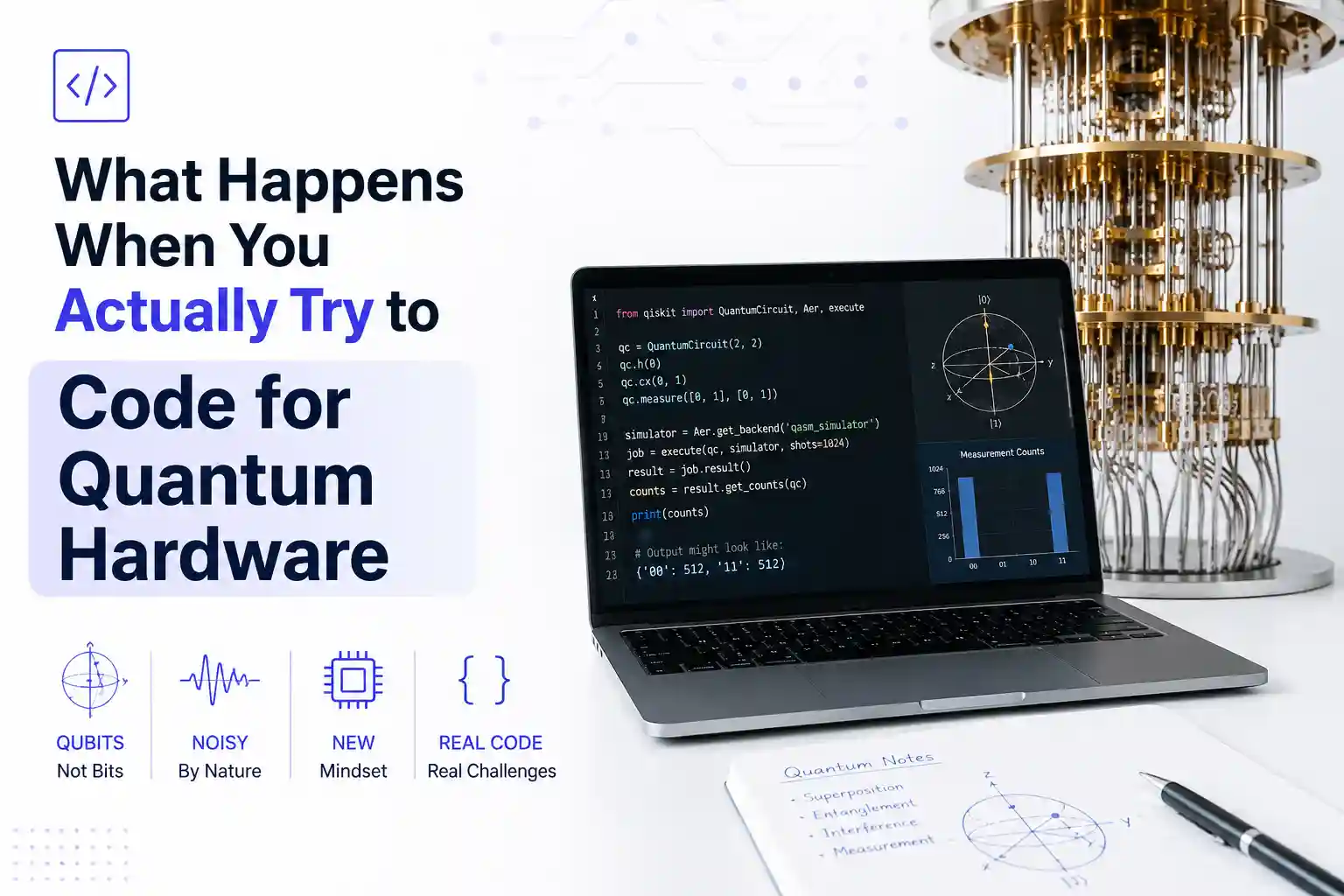
Over several evenings, I walked through a simple experiment: implementing a variational quantum eigensolver (VQE) workflow on IBM Quantum Experience, then attempting to port similar logic to Amazon Braket. The goal wasn’t to solve a chemistry problem—it was to document the developer experience end-to-end.
Setup and Learning Curve
IBM’s Qiskit documentation is comprehensive, but “comprehensive” isn’t the same as “beginner-friendly.” The tutorial assumes familiarity with Dirac notation, Hamiltonian mechanics, and basic linear algebra. If you’re coming from classical cloud development, expect to spend at least 10–15 hours just getting comfortable with the mental model shift. Quantum circuits aren’t functions; they’re probabilistic state transformations. That conceptual jump trips up even experienced engineers.
Coding Workflow and Execution
Writing a simple circuit in Qiskit feels intuitive at first. You define qubits, apply gates, and measure results. But complexity scales awkwardly. Add error mitigation? You’re now managing calibration data, backend properties, and noise models. Try to run on real hardware? Queue times vary from minutes to hours, depending on system load. And when your job finally executes, the output isn’t a clean answer—it’s a distribution of bitstrings you need to post-process statistically.
What Worked
Simulators: Local and cloud-based simulators (like Qiskit Aer) are reliable for testing circuit logic. If your algorithm works in simulation, you’ve at least validated the mathematical structure.
Hybrid workflows: Frameworks that let you mix classical preprocessing with quantum subroutines (like PennyLane or Qiskit Runtime) feel more practical for near-term use cases.
Community examples: GitHub repositories with working notebooks saved hours of debugging. The quantum developer community is small but active.
What Failed (or Frustrated)
Documentation depth: Once you move beyond “Hello World” examples, documentation becomes sparse. Error mitigation strategies? Often buried in research papers, not developer guides.
Hardware access: Free-tier quantum hardware access is limited to older, noisier devices. Getting time on newer systems often requires enterprise contracts or research partnerships.
Result interpretation: Noisy Intermediate-Scale Quantum (NISQ) devices return probabilistic outputs. Distinguishing signal from noise requires statistical literacy that many application developers don’t have.
Cloud cost opacity: Running simulations at scale on AWS Braket or Azure Quantum isn’t cheap, and pricing models aren’t always transparent upfront.
The biggest surprise wasn’t technical—it was organizational. Even when a prototype “worked,” teams struggled to justify the integration cost. As one DevOps engineer told me: “If I can get 95% of the value with a classical heuristic that runs in seconds on a CPU, why would I add a quantum dependency that requires specialized knowledge, has unpredictable latency, and needs constant recalibration?”
Practical Industry Value: Who Actually Benefits Today?
Let’s be direct: quantum computing isn’t replacing classical infrastructure. But it’s finding niches where its unique properties offer exploratory advantages.
Who Benefits (Cautiously)
Pharmaceutical and materials research teams: Quantum chemistry simulations for small molecules show promise, but only when paired with classical HPC workflows. Companies like Roche and Boehringer Ingelheim run pilot projects, but expect 12–18 month evaluation cycles, not production deployments.
Financial modeling groups: Portfolio optimization and risk analysis prototypes exist, but most remain in research. JPMorgan and Goldman Sachs have published papers, but public details about production use are scarce.
Logistics and supply chain R&D: Combinatorial optimization problems map naturally to quantum approaches, but classical solvers (like Gurobi or OR-Tools) remain faster and more reliable for real-world scale.
Who Probably Doesn’t Need Quantum (Yet)
General enterprise application teams: If your problem runs efficiently on classical cloud infrastructure, adding quantum complexity introduces more risk than reward.
Startups without specialized talent: Quantum development requires physics-aware engineers. Hiring is difficult and expensive.
Teams needing deterministic results: Probabilistic outputs and noise make quantum systems unsuitable for applications requiring repeatable, auditable decisions.
Realistic Enterprise Expectations
Most enterprise quantum projects today are “learning investments.” Companies allocate modest budgets ($100K–$500K annually) to build internal expertise, not to ship quantum-powered products. The goal isn’t immediate ROI—it’s ensuring the organization isn’t caught off-guard if the technology matures faster than expected.
Infrastructure Cost Realities
Accessing quantum hardware via the cloud sounds simple, but costs accumulate quickly. A single complex job on a premium backend can cost $50–$200 in cloud credits. Multiply that by iterative development cycles, and budgets balloon. Meanwhile, maintaining classical infrastructure to preprocess inputs and post-process outputs adds hidden operational overhead.
Classical vs. Quantum Workflows (Comparison Insights)
Understanding where quantum fits requires comparing it directly to classical alternatives, not in theory, but in daily developer experience.
Workflow Realities
| Aspect | Classical Cloud Development | Quantum Cloud Development |
|---|---|---|
| Debugging | Stack traces, logs, deterministic reproduction | Statistical analysis, noise characterization, probabilistic outcomes |
| Testing | Unit tests, integration tests, CI/CD pipelines | Limited simulators, hardware queue delays, calibration drift |
| Performance | Predictable latency, scalable resources | Unpredictable queue times, hardware-specific optimizations |
| Team Skills | Standard software engineering + domain knowledge | Software engineering + quantum physics + linear algebra |
Cloud Platform Differences
IBM Quantum: Most mature developer tooling (Qiskit), strong academic partnerships, but hardware access tiers can feel restrictive. Best for teams prioritizing education and research prototyping.
Amazon Braket: Aggregates multiple hardware providers (IonQ, Rigetti, OQC), offering flexibility but adding abstraction complexity. Pricing is usage-based, which can surprise teams accustomed to fixed-cost classical instances.
Microsoft Azure Quantum: Tight integration with classical Azure services, but the Q# language has a steeper learning curve. Strong focus on error correction research, which is valuable long-term but less immediately applicable.
Google Quantum AI: Cutting-edge hardware (Sycamore), but limited public cloud access. Most collaborations require formal research agreements.
Beginner vs. Advanced Developer Experience
Beginners often hit a wall after completing tutorials. The jump from simulating a 5-qubit circuit to designing error-mitigated algorithms for 50+ qubits isn’t linear—it requires deep domain knowledge. Advanced developers, meanwhile, spend significant time managing hardware-specific constraints: qubit connectivity maps, gate fidelity variations, and calibration schedules. As one senior quantum engineer put it: “You’re not just writing code. You’re negotiating with physics.”
Hardware Access Limitations
Even with cloud access, not all quantum processors are equal. Older devices have higher error rates. Newer systems may be reserved for partner organizations. And all current hardware operates in the NISQ regime—meaning results require careful statistical interpretation. Expect to spend as much time analyzing output distributions as writing the original circuit.
Expert Analysis: The Infrastructure and Physics Reality Check
Quantum mechanics isn’t abstract when you’re building systems around it. Here’s what actually constrains real-world deployments.
Qubit Stability and Error Rates
Current superconducting qubits (like IBM’s or Google’s) maintain coherence for microseconds to milliseconds. That’s enough for shallow circuits, but complex algorithms require deeper circuits that exceed coherence times. Error rates per gate range from 0.1% to 1%—seemingly small, but they compound exponentially across hundreds of operations. Error correction exists in theory, but practical fault-tolerant systems likely require thousands of physical qubits per logical qubit. We’re not there yet.
Practical Infrastructure Limitations
Quantum processors don’t run in data centers alongside classical servers. They require dilution refrigerators operating near absolute zero, specialized control electronics, and shielded environments. Cloud access abstracts this complexity, but it also means you can’t “spin up” a quantum instance on demand like an EC2 box. Hardware maintenance, calibration, and upgrades happen on vendor schedules, not yours.
Energy and Cost Concerns
A single quantum system can consume 25–50 kW of power—mostly for cooling. While that’s comparable to a small classical server rack, the computational throughput per watt is currently far lower. For enterprises evaluating sustainability metrics, quantum workloads don’t yet offer efficiency advantages. They’re research investments, not green computing solutions.
Cybersecurity Implications (The Realistic View)
Yes, Shor’s algorithm threatens RSA encryption. But practical cryptanalysis requires millions of high-fidelity qubits with error correction. Most expert estimates place this 10–30 years away. That said, “harvest now, decrypt later” attacks are a legitimate concern for long-lived sensitive data. Organizations handling classified or decades-long confidential information should begin cryptographic agility planning—but panic migrations aren’t warranted.
Realistic Industry Timelines
Based on interviews with researchers at MIT, IEEE publications, and enterprise pilot reviews:
2024–2026: Continued NISQ-era experimentation. Hybrid quantum-classical algorithms for niche chemistry and optimization problems. No broad production deployments.
2027–2030: Early error-mitigated systems may show quantum advantage for specific, well-scoped problems. Enterprise adoption remains limited to R&D departments.
2030+: If error correction breakthroughs occur, broader applications become plausible. But this timeline depends on materials science advances, not just software.
As a Nature review article noted last year: “The path to practical quantum computing is not a straight line—it’s a series of engineering challenges that must be solved in parallel.”
Realistic Drawbacks: What Nobody Puts in the Press Release
If you’re evaluating quantum computing for enterprise use, you need to understand the friction points that don’t make it into vendor demos.
Unstable Environments
Quantum hardware isn’t like classical cloud infrastructure. A system calibrated Monday morning may drift by Tuesday afternoon. Jobs that succeeded yesterday might fail today due to environmental noise or hardware maintenance. This unpredictability complicates CI/CD pipelines and SLA planning.
Documentation Confusion
While core API docs are solid, advanced topics, error mitigation strategies, hardware-specific optimizations, and hybrid workflow patterns are often scattered across research papers, GitHub issues, and community forums. There’s no “Stack Overflow” equivalent with reliable, vetted answers for quantum development edge cases.
Hardware Limitations
Qubit connectivity matters. If your algorithm requires two-qubit gates between non-adjacent qubits, you need swap operations that increase circuit depth and error probability. Hardware topology constraints force algorithm redesigns that classical developers rarely encounter.
Unclear Learning Paths
Should your team learn Qiskit, Cirq, Q#, or PennyLane? Each has strengths, but skill transfer between frameworks isn’t seamless. And quantum physics knowledge isn’t optional—it’s required to debug effectively. Training programs exist, but they’re time-intensive and expensive.
Cloud Restrictions
Free tiers limit circuit depth, execution time, and hardware access. Paid tiers improve access but introduce cost uncertainty. And data egress? Moving large classical datasets to/from quantum cloud environments adds latency and expense, often overlooked in initial planning.
Unrealistic Marketing Hype
“Quantum supremacy” headlines obscure practical reality. A device solving a contrived problem faster than a classical supercomputer doesn’t mean it can accelerate your business logic. Evaluate claims against your specific use case, not press releases.
References & Authority: Grounding the Analysis
This analysis draws from:
- IBM Quantum developer documentation and enterprise case studies (2023–2024)
- Google Quantum AI technical reports on Sycamore processor performance
- MIT Center for Quantum Engineering industry partnership reviews
- IEEE Transactions on Quantum Engineering peer-reviewed assessments of NISQ applications
- Nature and Science articles on quantum error correction progress
- Enterprise computing studies from Gartner and McKinsey on quantum adoption barriers
Where possible, I’ve prioritized sources that discuss real-world constraints over theoretical potential. The goal isn’t to dismiss quantum computing—it’s to contextualize its current role in practical technology ecosystems.
Final Thoughts: Where Quantum Mechanics Actually Exists in Real Life
Quantum mechanics isn’t waiting in some distant future to transform computing. It exists today—in research labs, in cloud sandbox environments, in the careful calculations of teams exploring whether these systems can solve problems classical computers struggle with.
But “exists” doesn’t mean “ready for production.” The gap between a working prototype and a reliable enterprise system is filled with infrastructure challenges, skill shortages, and physics constraints that no amount of marketing can wish away.
If you’re a developer curious about quantum: start small. Use simulators. Contribute to open-source frameworks. Build your intuition before betting project timelines on hardware access.
If you’re an enterprise decision-maker: treat quantum as a strategic learning investment, not a near-term solution. Allocate modest resources to build internal expertise. Partner with vendors who are transparent about limitations. And always ask: “What classical approach have we fully exhausted first?”
The most practical quantum computing advice I’ve heard came from a senior engineer at a Fortune 500 company: “Don’t chase quantum because it’s novel. Chase it because you’ve rigorously validated that your problem maps to its strengths—and you’re prepared for the friction that comes with pioneering.”
That’s where quantum mechanics exists in real life today: not in revolution, but in careful, skeptical, incremental exploration. And for teams willing to embrace that reality, there’s genuine value to be found—not in hype, but in understanding.