



Quantum Supremacy: Why the World is About to Change (A Practical Reality Check)
It Started With a Frustrated Tuesday Morning
Last month, a senior engineer at a Fortune 500 logistics firm messaged me after spending three weeks trying to prototype a quantum-optimization workflow for route planning. “I can get the simulator to run a 12-city problem,” he wrote. “But the moment I add real-world constraints, traffic patterns, delivery windows, vehicle capacity, the circuit depth explodes, the error rates become unusable, and I’m back to square one with classical heuristics.” He wasn’t complaining about quantum computing being “too hard.” He was pointing out something more fundamental: the gap between marketing headlines about quantum supremacy and the actual developer experience of building something that works.
That friction isn’t anecdotal. It’s structural. And it’s the reason why, despite genuine progress in quantum hardware and algorithms, most enterprise teams exploring quantum computing today find themselves navigating a landscape of promising research, confusing documentation, and infrastructure constraints that rarely make it into press releases.
I’ve spent the last 18 months testing quantum development platforms, interviewing enterprise architects, and reviewing technical roadmaps from IBM Quantum, Google Quantum AI, and emerging neutral-atom players. What follows isn’t hype. It’s a practical assessment of where quantum computing actually stands for developers, infrastructure teams, and business leaders trying to separate signal from noise.

What Actually Happens When You Try to Build Something
Let me walk you through a realistic testing scenario, not a demo, not a thought experiment, but the kind of hands-on exploration a developer might undertake when evaluating quantum tools for a real project.
The setup: I started with IBM Quantum Experience, primarily because it offers free tier access, relatively mature documentation, and a browser-based composer that lowers the initial barrier to entry. The goal wasn’t to solve a business problem but to understand the workflow: how do you go from a conceptual algorithm to executable code, and what breaks along the way?
The learning curve: The introductory tutorials are genuinely well-designed. You can drag-and-drop gates, visualize state vectors, and run simple circuits on simulators within minutes. But here’s where the friction begins: once you move beyond textbook examples — say, implementing a variational quantum eigensolver for a molecule larger than hydrogen, the documentation becomes fragmented. You’re toggling between Qiskit API references, research papers on arXiv, and community forums where answers are often outdated or hardware-specific.
The coding workflow: Writing quantum code feels less like traditional software development and more like negotiating with physics. You’re not just debugging logic errors; you’re managing qubit coherence times, gate fidelity constraints, and topology limitations (which qubits can actually interact with). A circuit that runs perfectly on a simulator may fail on real hardware, not because of a bug in your code, but because the physical qubits drifted out of calibration during your job’s queue time.
What worked: For educational purposes and small-scale algorithm prototyping, the IBM platform is impressive. The ability to switch between ideal simulation, noisy simulation, and real hardware execution helps build intuition about error sources. The feedback program IBM runs shows they’re listening to developer pain points around documentation and tooling.
What failed: Scaling beyond toy problems revealed hard limits. A 20-qubit circuit with moderate depth might execute on a simulator in seconds. On real hardware? You’re looking at queue times, calibration windows, and error rates that make results statistically noisy. And if you need to iterate, which you always do in development, the feedback loop stretches from minutes to hours or days.
This isn’t unique to IBM. Google Quantum AI’s Cirq framework offers powerful low-level control but demands deeper quantum physics knowledge. Amazon Braket abstracts hardware differences but adds another layer of configuration complexity. The pattern is consistent: the more powerful the tool, the steeper the expertise cliff.
Who Actually Benefits From Quantum Computing Today?
Let’s be direct: if you’re running a typical enterprise IT operation, managing databases, web services, or standard analytics pipelines, quantum computing is not on your critical path. Not yet. Maybe not for a decade.
Who benefits now: Research institutions and specialized R&D teams working on problems with inherent quantum structure. Think materials science labs simulating molecular interactions, or fundamental physics groups exploring quantum many-body systems. These domains align naturally with quantum hardware’s strengths, and even noisy intermediate-scale quantum (NISQ) devices can provide insights that classical systems struggle to match.
Who’s experimenting wisely: Financial institutions testing quantum-inspired optimization for portfolio analysis, or logistics firms prototyping hybrid quantum-classical workflows for specific sub-problems. The keyword is hybrid. In 2026, the absolute gold standard is Hybrid Quantum-Classical Computing, not standalone quantum supremacy. These teams aren’t betting their core infrastructure on quantum; they’re running controlled experiments to understand where quantum might eventually add value.
Who probably doesn’t need to worry yet: Most enterprise software teams. If your problem can be solved with classical machine learning, distributed computing, or even specialized hardware like GPUs or TPUs, quantum computing likely introduces more complexity than benefit. The infrastructure cost realities are stark: a 100-qubit system’s control infrastructure can cost $1 million to $3 million, with larger systems requiring even more investment.
Adoption barriers that matter: Beyond hardware access, enterprises face talent shortages (quantum-literate engineers are rare), unclear ROI timelines, and integration challenges with existing HPC infrastructure. You can’t just “plug in” a quantum processor to your data pipeline. The entire workflow, from problem formulation to result validation, needs rethinking.
Classical vs. Quantum Workflows: A Developer’s Perspective
One of the most under-discussed aspects of quantum adoption is workflow disruption. Classical software development has decades of accumulated tooling: debuggers, profilers, version control integrations, CI/CD pipelines. Quantum development? We’re rebuilding that stack from scratch.
Platform differences: IBM Quantum emphasizes accessibility and education, making it a good starting point for teams new to quantum. Google Quantum AI focuses on pushing hardware boundaries and algorithmic innovation, appealing to researchers comfortable with lower-level control. Neutral-atom platforms like QuEra offer different qubit connectivity advantages but require learning new programming abstractions. There’s no “best” platform, only the one that aligns with your specific problem and expertise.
Beginner vs. advanced experience: For newcomers, the initial learning curve is manageable thanks to high-level frameworks like Qiskit or Cirq. But advancing beyond tutorials requires understanding quantum error correction, pulse-level control, and hardware-specific constraints, knowledge that overlaps more with physics than traditional software engineering. This creates a talent bottleneck that slows enterprise adoption.
Hardware access limitations: Even with cloud-based quantum services, access isn’t unlimited. IBM rationalizes real-hardware execution time via processing units; Google prioritizes research partners; emerging providers have limited capacity. This isn’t just an inconvenience — it fundamentally changes how you develop. You can’t iterate rapidly when each test run requires queuing and may return hours later with noisy results.
Enterprise vendor comparisons: When evaluating quantum providers, look beyond qubit counts. Ask about: calibration stability (how often do you need to re-tune?), error mitigation tools, classical simulation fallbacks, and integration support with existing cloud infrastructure. A vendor with fewer qubits but better tooling and support may deliver more practical value than a headline-grabbing hardware demo.
Expert Analysis: The Physics Behind the Hype
Let’s talk about qubit stability, not in abstract terms, but in ways that impact real development work.
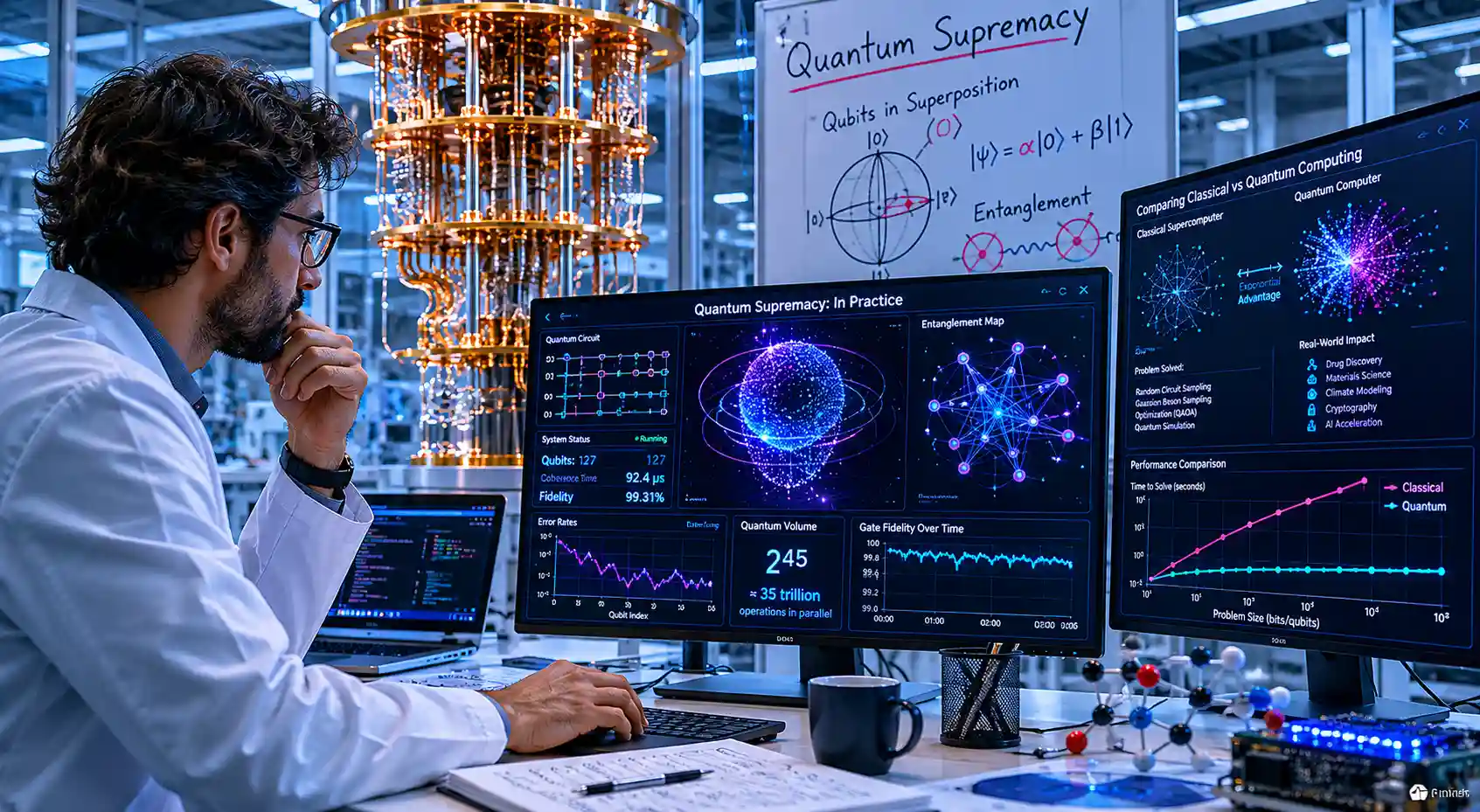
Qubits aren’t just fragile; they’re environmentally sensitive. Superconducting qubits (used by IBM and Google) require millikelvin temperatures and extreme isolation from electromagnetic noise. Even minor fluctuations can cause decoherence, scrambling your computation before it finishes. This isn’t a software bug you can patch; it’s a fundamental constraint of the hardware.
Practical infrastructure limitations: Running quantum hardware isn’t like spinning up a VM. You need dilution refrigerators, specialized control electronics, and shielded facilities. This is why quantum computing remains largely cloud-accessible rather than on-premise — and why even cloud access comes with scheduling constraints and usage quotas. The billion-dollar opportunity of on-premise quantum computing exists, but integration costs with existing HPC infrastructure remain a major barrier.
Energy and cost concerns: While a single quantum computation might use less energy than a classical supercomputer for specific tasks, the overhead of maintaining quantum hardware is enormous. Cryogenic systems, control electronics, and error correction protocols consume significant power. For enterprises, this translates to high operational costs that aren’t always reflected in per-job pricing models.
Cybersecurity implications: Yes, quantum computers threaten current encryption standards, but not tomorrow. The timeline for a cryptographically relevant quantum computer remains uncertain, with most experts estimating 10+ years. However, the “harvest now, decrypt later” threat means organizations handling long-lived sensitive data should start planning post-quantum cryptography migration now. The Quantum Computing Cybersecurity Preparedness Act in the U.S. is pushing federal agencies to inventory vulnerable systems and develop transition roadmaps.
Realistic industry timelines: IBM’s public roadmap projects hundreds to thousands of logical qubits by the early 2030s. Google’s five-stage framework outlines a path from NISQ-era experiments to fault-tolerant utility. But “logical qubits” — error-corrected, reliable computational units — are the real metric that matters. We’re likely 5-10 years away from quantum systems that can reliably outperform classical supercomputers on commercially relevant problems.
The Drawbacks Nobody Talks About Enough
Let’s get uncomfortable for a moment. Beyond the technical challenges, quantum computing faces adoption hurdles that rarely make it into vendor presentations.
Unstable environments: Quantum hardware isn’t like classical servers. Calibration drifts. Qubits degrade. Maintenance windows are frequent and unpredictable. If your development workflow depends on consistent hardware behavior, you’ll spend significant time managing instability rather than building features.
Documentation confusion: As noted earlier, quantum documentation often assumes graduate-level physics knowledge. API references may lack practical examples. Community support is growing but still sparse compared to classical frameworks. This isn’t a criticism of quantum teams — it’s a reflection of a field still maturing its developer experience.
Hardware limitations: Qubit connectivity matters. Not all qubits can interact directly, forcing you to add SWAP gates that increase circuit depth and error rates. This topology constraint can make theoretically efficient algorithms impractical on real hardware.
Unclear learning paths: How do you become a quantum developer? There’s no standardized certification path (though IBM has started offering quantum certifications), no universal curriculum, and limited mentorship opportunities outside major research hubs. This talent gap slows enterprise adoption more than hardware limitations in many cases.
Cloud restrictions: Free tiers are great for learning, but insufficient for serious development. Paid tiers offer more access but at costs that can escalate quickly for iterative workflows. And vendor lock-in is real: code written for one platform’s abstractions may not port easily to another.
Unrealistic marketing hype: This is perhaps the most damaging barrier. When vendors overpromise on timelines or capabilities, they set up enterprise teams for disappointment. A practical framework for evaluating quantum claims — like the one proposed by Olivier Ezratty, assessing industry value, working hardware, and provable advantage- is essential for cutting through the noise.
References & Authority: Where to Look for Reliable Information
When researching quantum computing, prioritize sources that balance technical depth with a practical perspective:
IBM Quantum: Strong on documentation, developer tools, and transparent roadmaps. Their feedback program shows commitment to improving user experience.
Google Quantum AI: Leading in hardware innovation and algorithmic research, with publications in Nature detailing breakthroughs in error correction and quantum advantage experiments.
MIT and academic research: For foundational advances and critical analysis. Look for peer-reviewed papers rather than press releases.
IEEE and Nature journals: Rigorous peer review helps separate genuine progress from premature claims.
Enterprise computing studies: Reports from Gartner, McKinsey, or the Quantum Economic Development Consortium provide realistic adoption assessments grounded in business needs.
Be skeptical of sources that: lead with qubit counts without context, promise near-term business transformation, or lack technical documentation supporting their claims.
Final Thoughts: Pragmatism Over Hype
Quantum computing is advancing. The progress in error correction, qubit coherence, and algorithm design over the past five years is genuine and impressive. But “quantum supremacy,” the point where quantum computers solve problems classical systems cannot, remains a research milestone, not a business inflection point.
For enterprise leaders: start with education, not investment. Build internal quantum literacy. Run small, well-scoped experiments with clear success criteria. Partner with vendors who prioritize transparency over hype. And remember: the goal isn’t to “adopt quantum” but to understand where and when it might eventually solve problems your classical systems cannot.
For developers: embrace the learning curve, but manage expectations. Quantum programming is a specialized skill that complements — rather than replaces- classical expertise. Contribute to open-source tools, document your friction points, and help shape the developer experience for the next wave of adopters.
The world isn’t about to change overnight because of quantum computing. But for teams willing to engage with its real challenges and opportunities, not the marketing version, the next decade could bring genuinely transformative capabilities. The key is patience, pragmatism, and a commitment to separating what’s possible today from what’s promised tomorrow.
That’s not a disappointing conclusion. It’s a realistic one. And in a field crowded with hype, realism is the most valuable insight of all.