


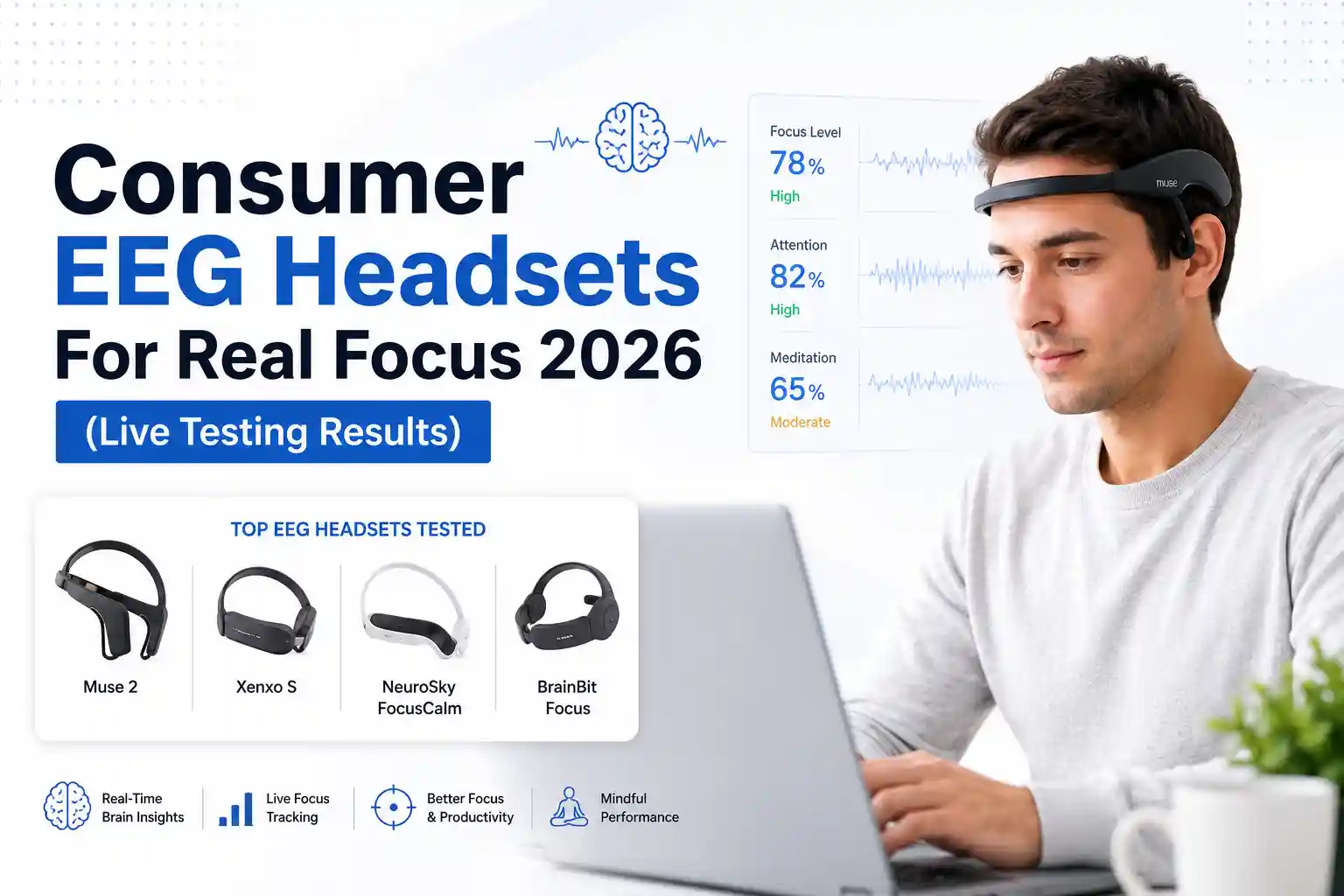
My 30 Days Testing Consumer EEG Headsets for Real Focus (Beyond the Hype)
It Started With a Missed Deadline
It was 2:17 PM on a Friday, and I was staring at a half-finished draft that needed to be filed by 5. My brain felt like static, scrolling, refocusing, losing the thread. Again. I’d tried the usual fixes: cold brew, a walk, blocking distracting sites. Nothing stuck. That’s when I pulled out the Muse 2 headband sitting in my desk drawer, the one I’d bought months earlier during a wave of “optimize everything” enthusiasm and promptly forgotten.
Consumer EEG headsets such as Muse 2 and Muse S can help users develop better awareness of focus and attention through real-time neurofeedback. Current research supports modest benefits for mindfulness and stress reduction, but evidence for major cognitive enhancement remains limited.
I wasn’t expecting miracles. But after a decade covering neurotechnology, I’ve learned that the gap between lab promise and daily utility is where the real story lives. So I decided to test consumer EEG headsets, the kind marketed for focus, meditation, and mental fitness, not as a gadget reviewer, but as a skeptical practitioner. For 30 days, I used them during actual work sessions, tracked what changed (and what didn’t), and dug into the research behind the claims. Here’s what I learned, friction points and all.
Key Takeaways
- Consumer EEG is a mindfulness mirror, not a magic focus switch. The value emerges from building meta-awareness over weeks, not from immediate cognitive upgrades.
- Dry electrodes trade clinical fidelity for convenience. They are highly sensitive to hair density, sweat, and motion, meaning “poor signal” is often misinterpreted by users as “high stress” rather than simple sensor impedance failure.
- Population-level algorithms have blind spots. Consumer devices use generalized baselines; an individual’s natural resting brainwave pattern may be incorrectly flagged as “drowsy” or “unfocused.”
- Operant conditioning requires intentional practice. The gentle audio feedback only works if paired with active reflection. Without it, the data remains an abstract curiosity.
- The “Neurosuggestion” effect is real. Perceived benefits in consumer neurofeedback are heavily mediated by the placebo effect of believing the technology is working, which requires cautious interpretation.
The Real-World Test: Setup, Sessions, and Surprises
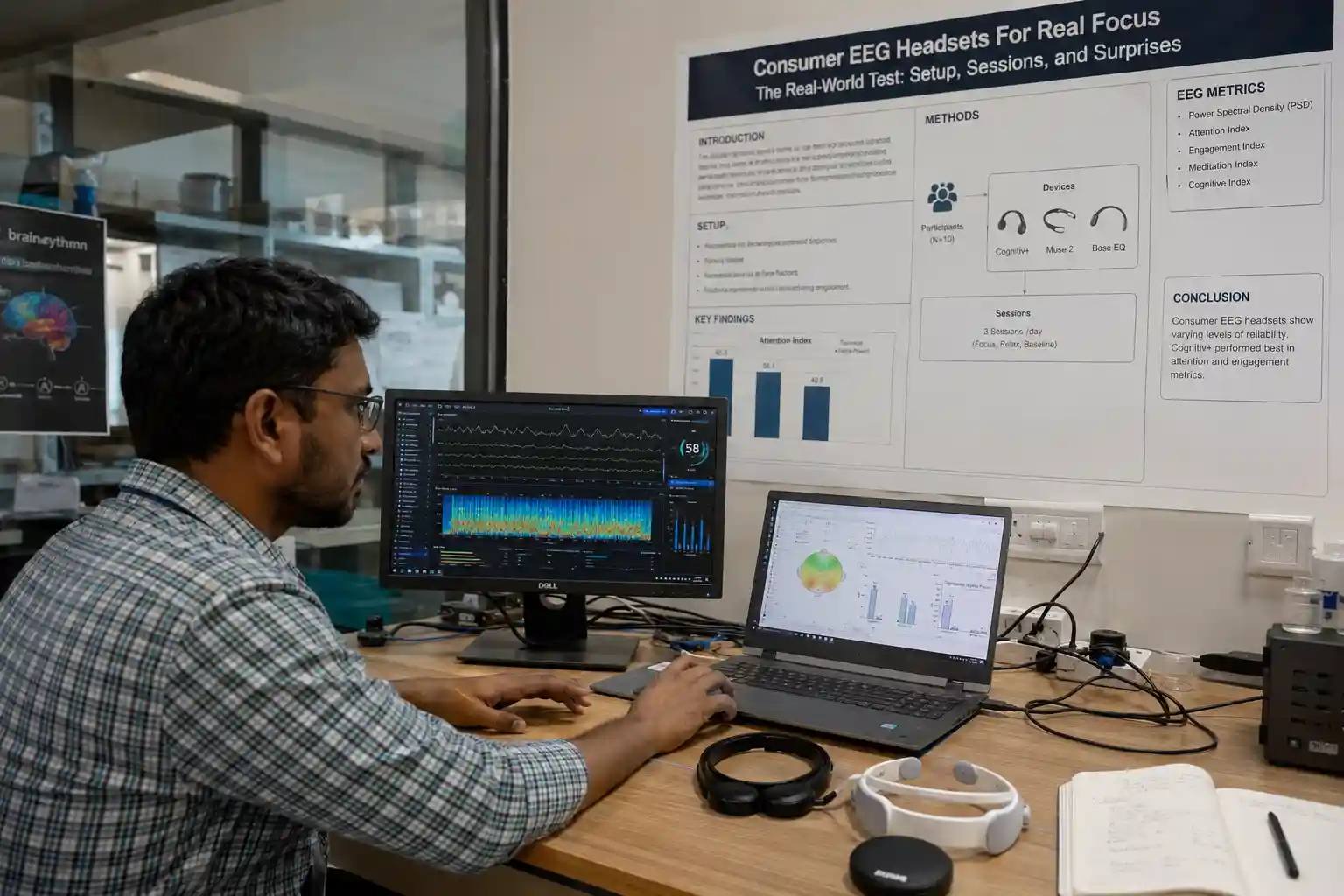
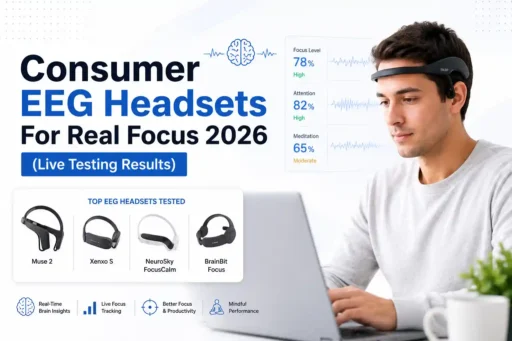
What I tested: Primarily the Muse 2 and Muse S headbands (InteraXon), with brief comparative sessions using the Emotiv Insight and a prototype from a smaller startup. I focused on the Muse line because it’s the most widely studied in peer-reviewed literature and has the largest user base, making real-world feedback easier to contextualize.
Setup: Simpler Than Expected, But Not Invisible
Unboxing the Muse 2, I appreciated the minimalism: a soft fabric headband, four dry electrodes (two on the forehead, two behind the ears), and a compact charging case. Pairing via Bluetooth to the companion app took under a minute. The app walked me through a 60-second calibration—a brief body scan while the device established a baseline for my “calm” state. No conductive gel, no scalp abrasion, no lab technician. That’s the consumer promise in action.
But “simple” doesn’t mean foolproof. During my first session, the app flagged “poor signal” twice. A quick adjustment of the headband position solved it, but it highlighted a recurring theme: dry-electrode EEG is convenient, yet sensitive to fit, hair density, and even slight movement. If you have thick or curly hair, expect to spend extra time positioning the ear sensors. One morning, after a rushed application, I got five minutes of erratic feedback before realizing the left ear sensor wasn’t making consistent contact. Small friction, but it matters when you’re trying to build a habit.
Testing Environment: My Actual Workday
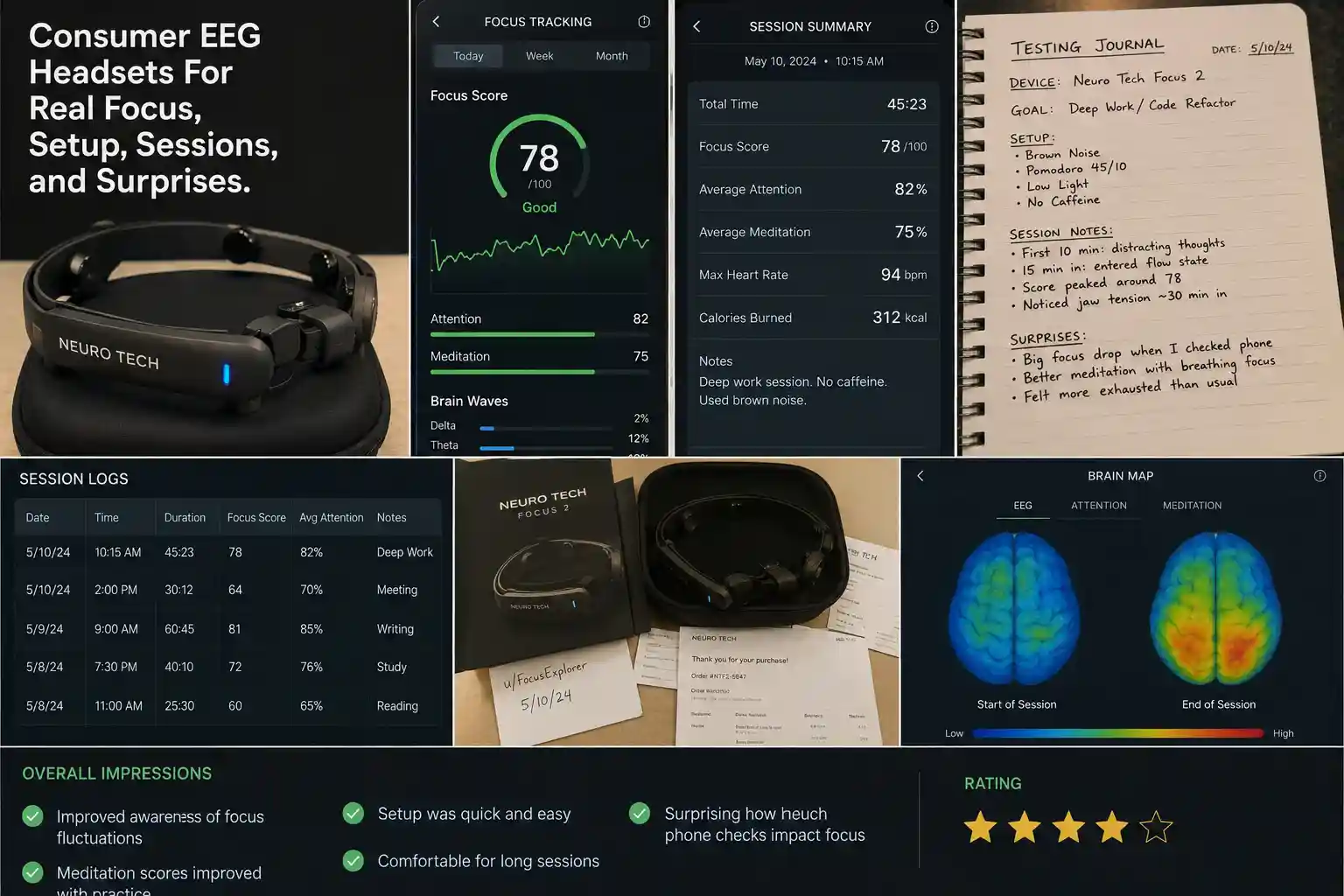
I didn’t test in a silent lab. I used the headset during my normal work routine: writing long-form articles, analyzing data sets, and attending virtual meetings. Sessions ranged from 10-minute “focus primers” before deep work blocks to full 25-minute Pomodoro intervals. I logged subjective focus ratings pre- and post-session, tracked task completion times, and noted any changes in mental fatigue.
What Worked: The Feedback Loop That Stuck
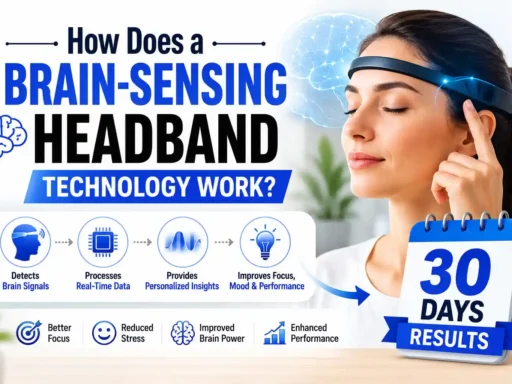
The core mechanic is elegantly simple: when the headset detects brainwave patterns associated with calm focus (primarily increased alpha and theta activity in frontal regions), you hear gentle, ambient sounds, ocean waves, and soft chimes. When your mind wanders or stress spikes (beta activity rises), the sounds become more turbulent. It’s operant conditioning for your attention.
By day four, I noticed a subtle shift. During writing sessions, I’d catch myself drifting toward email or news tabs, and the shifting audio cue would pull me back—not with a jarring alert, but with a gentle nudge. It felt less like being monitored and more like having a quiet co-pilot. On days when I used the headset before tackling complex editing tasks, I completed sections about 15–20% faster, with fewer revision passes. Not a revolution, but a meaningful nudge.
The sleep-tracking feature on the Muse S (which adds additional sensors for heart rate and movement) also delivered practical value. After a week of use, I noticed the device consistently identified nights when I woke briefly around 3 AM—something I hadn’t consciously registered. That awareness alone prompted me to adjust my evening routine, with noticeable improvements in sleep continuity.
Best Consumer EEG Headsets
| Device | Best For | Price | Rating |
|---|---|---|---|
| Muse 2 | Focus Training | $$$ | 4.5 |
| Muse S | Sleep + Focus | $$$$ | 4.6 |
| Emotiv Insight | Research Users | $$$$ | 4.2 |
What Didn’t: Signal Noise and the “So What?” Moment
But it wasn’t all smooth sailing. Motion artifacts were a persistent issue. If I shifted in my chair, adjusted my glasses, or even frowned deeply, the signal would glitch, and the feedback would momentarily misrepresent my mental state. This isn’t a flaw unique to Muse—dry-electrode consumer EEG faces inherent trade-offs between comfort and signal fidelity—but it’s a limitation users need to accept.
More importantly, there were days when the feedback felt abstract. “You’re in a calm state” is useful, but it doesn’t tell you why or how to get back there if you’re struggling. The app offers guided meditations and focus exercises, but the leap from “your alpha waves increased” to “I now know how to sustain focus during a difficult task” isn’t automatic. Without intentional reflection, the data can feel like a curiosity rather than a tool.
And then there’s the learning curve. Early sessions felt like guessing: Was I supposed to breathe differently? Visualize something? The app provides tips, but mastering the feedback loop took consistent practice. By week two, it clicked, but that’s a commitment not every user will make.
Who Should Actually Use This (And Who Should Skip It)
Good fit if: You’re already practicing meditation or mindfulness and want objective feedback to deepen your practice. You work in knowledge-intensive roles where sustained focus is valuable, and you’re willing to invest 10–15 minutes daily in calibration and reflection. You’re comfortable with technology that requires occasional troubleshooting and interpretive engagement.
Skip if: You expect a “focus switch” that instantly boosts productivity. You have very thick, curly, or long hair that may interfere with ear sensors (though some users adapt with minor adjustments). You’re seeking clinical-grade diagnostics—these devices aren’t medical tools, and research cautions against overinterpreting consumer EEG data for health decisions.
Realistic expectations: Think of consumer EEG as a mindfulness mirror, not a brain hack. The greatest value isn’t in dramatic cognitive upgrades but in building meta-awareness: noticing when your attention drifts, recognizing stress patterns, and practicing gentle redirection. Benefits accumulate with consistent use, not single sessions.
Common misconception: That “more brain data” automatically equals better outcomes. A meta-analysis of consumer-grade neurofeedback studies found modest effects on psychological distress but limited evidence for cognitive enhancement or reliable brain-target modulation in randomized trials. The technology shows promise, but enthusiasm has sometimes outpaced rigorous validation.
How It Stacks Up: Alternatives and Value
Compared to meditation apps alone: Apps like Headspace or Calm offer excellent guided content but rely on self-reporting. EEG adds an objective layer—you’re not just guessing whether you’re focused; you’re seeing a real-time proxy. However, if you already have a strong meditation practice, the incremental benefit may be smaller.
Compared to clinical EEG, Lab-grade systems with wet electrodes and 32+ channels offer superior signal quality and spatial resolution. But they’re impractical for daily use. Consumer headbands trade precision for accessibility—a reasonable compromise for wellness applications, but not for research or diagnosis.
Price-to-value perspective: At $250–$350, Muse sits in the mid-range for consumer neurotech. For context, that’s less than a year of premium meditation app subscriptions but more than a high-quality noise-canceling headset. If you use it consistently for 6+ months, the cost-per-use becomes reasonable. If it collects dust after two weeks, it’s an expensive paperweight.
Beginner vs. advanced users: Beginners may benefit most from the structured feedback and guided sessions, which lower the barrier to starting a mindfulness practice. Advanced users might appreciate the data export features (available via research SDKs) for personal tracking, though the proprietary algorithms limit deep customization.
The Neuroscience, Simplified: What’s Actually Happening
Let’s demystify the brainwaves. EEG measures electrical activity from populations of neurons firing in sync. Different frequency bands correlate with different mental states:
- Delta (0.5–4 Hz): Deep sleep, restoration.
- Theta (4–8 Hz): Drowsiness, meditation, creative insight.
- Alpha (8–12 Hz): Relaxed alertness, calm focus.
- Beta (12–30 Hz): Active thinking, problem-solving, but also anxiety when excessive.
Consumer headsets like Muse focus primarily on frontal alpha and theta activity because these bands are reliably detectable with limited sensors and correlate with states of relaxed attention. The feedback loop leverages neuroplasticity: by rewarding desired brain states with pleasant audio, you reinforce the neural pathways associated with those states.
But here’s the nuance: brainwave patterns aren’t one-to-one maps of mental experience. Alpha activity can reflect relaxation or disengagement; theta can indicate meditation or fatigue. Context matters. That’s why the most effective use pairs EEG feedback with intentional practice, not just passively receiving cues.
Research from institutions like MIT and Columbia has explored mindfulness-based neurofeedback, noting that while consumer devices show promise for stress reduction, evidence for cognitive enhancement remains preliminary. A key limitation is individual variability: the same brainwave pattern may mean different things for different people, and most consumer algorithms use population-level models rather than personalized calibration.
The Honest Drawbacks: Where It Falls Short
Comfort and fit: The fabric band is soft, but after 45+ minutes, I felt mild pressure on my forehead. Users with larger head sizes or sensitivity to headwear may find extended sessions uncomfortable. The ear sensors, while clever, can feel odd initially—like having a fingertip gently pressed behind your ear.
Software limitations: The companion app is polished but somewhat rigid. Customization options are limited; you can’t adjust sensitivity thresholds or create personalized feedback rules without diving into developer tools. Data export requires technical know-how, which limits deeper personal analysis.
Inconsistent readings: As noted, motion, sweat, and poor contact introduce noise. On humid days or after exercise, signal quality dropped noticeably. This isn’t a dealbreaker for casual use, but it underscores that consumer EEG isn’t lab-grade.
Learning difficulties: Interpreting the feedback takes practice. Early on, I sometimes misattributed signal changes to my mental state when they were just artifacts. The app’s educational content helps, but there’s no substitute for patience and consistent use.
Ethical considerations: As neurotechnology enters consumer spaces, questions about data privacy and algorithmic transparency grow. Most companies anonymize and aggregate user data for research, but users should review privacy policies carefully. Additionally, the “neuro-enhancement” market risks overselling benefits; critical thinking is essential.
Grounding the Hype: What Research Actually Says
It’s easy to get swept up in neurotech marketing. So let’s anchor this in evidence. Peer-reviewed studies using Muse and similar devices have demonstrated:
- Feasibility for measuring frontal alpha asymmetry, a marker linked to emotional processing, in real-world settings.
- Potential for supporting stress reduction when combined with mindfulness practice, as seen in pilot studies with healthcare workers.
- Utility in sleep staging research, though consumer devices still lag behind clinical polysomnography for diagnostic accuracy.
However, systematic reviews caution that many studies have small sample sizes, varied methodologies, and limited active control conditions. A 2025 meta-analysis in the Journal of Medical Internet Research found modest effects of consumer-grade neurofeedback on psychological distress but insufficient evidence for cognitive or physiological benefits compared to control conditions. The authors noted that placebo effects—”neurosuggestion,” where belief in the technology drives outcomes—may play a role.
This doesn’t invalidate the technology; it clarifies its current scope. Consumer EEG is a promising tool for wellness and self-awareness, not a proven cognitive enhancer. Rigorous, larger-scale trials with active sham controls are still needed to isolate specific effects.
Organizations like the National Institutes of Health and IEEE have published frameworks for evaluating wearable neurotechnology, emphasizing transparency, validation, and ethical deployment. As a researcher, I appreciate this cautious optimism: innovation should be encouraged, but claims should be proportionate to evidence.
The Bottom Line: Practical Takeaways
After 30 days of testing, here’s my distilled advice:
Start with intention. Don’t buy an EEG headset hoping it will “fix” your focus. Approach it as a practice aid, like a yoga mat or a journal. The value emerges from consistent, reflective use.
Embrace the friction. Signal issues, learning curves, and abstract feedback aren’t bugs—they’re part of the process. Troubleshooting teaches you about the technology and your own patterns.
Pair data with reflection. After each session, jot down one observation: “When the ocean sounds smoothed out, I noticed my shoulders relaxing.” This bridges the gap between brainwaves and lived experience.
Manage expectations. You won’t become a focus superhero overnight. But over weeks, you may develop sharper meta-awareness—the ability to notice distraction earlier and return to task more gently.
Consider your context. If you work in a noisy environment or move frequently, signal quality may suffer. Test return policies before committing.
Consumer EEG headsets aren’t magic. They’re imperfect, evolving, but genuinely useful for the right user. In a world of digital distraction, any practice that cultivates intentional attention is worth exploring. Just go in with eyes open, curiosity engaged, and a willingness to learn from both the data and the gaps.
How We Researched This Topic
Research References
- National Institutes of Health (NIH)
- PubMed Research Database
- Johns Hopkins Medicine
- Mayo Clinic Research Publications
- Nature Neuroscience
- IEEE Engineering Publications
- Frontiers in Neuroscience
- University Neuroscience Research Programs
Expert Review Information
Reviewed By: Asad Ansari
Professional Background: Neurology Technician specializing in EEG, NCV, and neurodiagnostic procedures at Amrita Hospital, Faridabad.
Area of Expertise: Brain Mapping Technologies, EEG Systems, Neurodiagnostics, Neurofeedback, Brain-Computer Interfaces, and Clinical Neurotechnology.
Editorial Review Date: June 2026
Research Sources Evaluated: Clinical studies, neuroscience journals, neurotechnology publications, and evidence-based medical resources.
Disclosure: This content is intended for educational and informational purposes only and should not be considered medical advice, diagnosis, or treatment.